Human Anatomy, Part 1 - K. A. Dyubenko, A. K. Kolomiytsev, Yu. B. Chaykovsky 2002
Special Section
Urinary System, systema urinarium – General Overview
Urinary Organs – Male Urethra
The male Urethra, or urethra masculina, is a hollow, unpaired tubular organ. It originates at the internal urethral orifice, ostium urethrae internum, in the anteroinferior part of the Urinary Bladder and terminates at the external urethral orifice, ostium urethrae externum, on the glans Penis (Fig. 316). The urethra is traditionally divided into three parts:
- the prostatic part, pars prostatica;
- the membranous part, pars membranacea;
- the spongy part, pars spongiosa.
The prostatic part, pars prostatica, runs vertically through the Prostate Gland, measuring 30–35 mm in length. Its middle section is dilated, while its initial and terminal portions are narrowed. On the posterior wall of the prostatic part lies the urethral crest (seminal colliculus), colliculus seminalis, flanked by numerous excretory ducts of the prostate gland.
Class="center">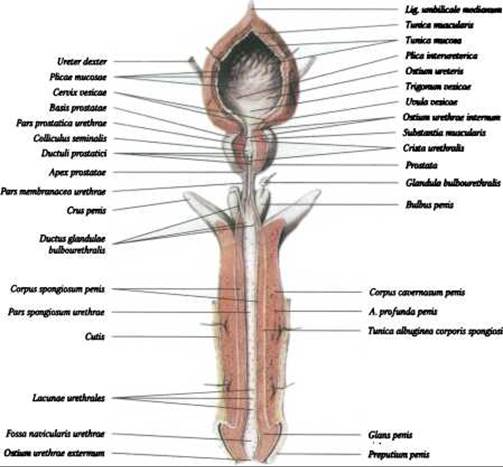
Fig. 316. Male urethra, urethra masculina; corpus cavernosum of the penis, corpus cavernosum penis, prostate gland, prostata; urinary bladder, vesica urinaria in section (after R. D. Sinelnikov)
The membranous part, pars membranacea, pierces the urogenital Diaphragm over a length of 15–20 mm, extending from the apex of the prostate to the bulb of the penis. The diameter of the membranous part ranges from 3 to 4 mm. This is the narrowest section of the urethra, which must be carefully accounted for when passing instruments through the urethra into the bladder. The membranous part is surrounded by bundles of striated and smooth Muscle fibers that form the voluntary urethral sphincter, m. sphincter urethrae.
The spongy part, pars spongiosa, is the longest section of the urethra, measuring 100–120 mm in length. It is subdivided into the bulbous and pendulous parts, with a lumen diameter of 6–10 mm. Numerous urethral glands, gll. urethrales, and the ducts of the Bulbourethral Glands, gll. bulbourethrales (Cowper's glands), open into the bulbous part of the urethra.
The male urethra features three narrowings—at the internal orifice, in the membranous part, and at the external orifice—as well as three dilations—in the prostatic part, within the bulb of the penis, and near the external orifice in the navicular fossa, fossa navicularis. Throughout its length, the urethra forms two curvatures in the sagittal plane: a superior and an inferior one. In children, the prostatic part of the canal is relatively longer. The urethral lumen expands during the passage of semen and urine, as well as during the Introduction of medical instruments (such as catheters or cystoscopes).
In clinical practice, the urethra is divided into two main segments: the fixed posterior part and the mobile anterior part. The fixed segment is further subdivided into the intravesical (5–6 mm long), prostatic (30–35 mm), and membranous (15–20 mm) parts. The intravesical part is essentially the sphincter of the urinary bladder.
Last update: 08/08/2026
Editorial and Educational Adaptation: This material has been compiled based on the primary/original source text. The project team performed an editorial review, corrected technical inaccuracies, structured sections, and adapted the content for an educational format.
What was processed:
- elimination of formatting defects (OCR errors, structural breaks, corrupted characters);
- editorial organization of content;
- standardization of terminology in accordance with academic sources;
- verification of factual statements against the original source text.
All mentions of the author, publication year, and origin of the primary text have been preserved in accordance with the source.