MEDICAL BIOLOGY, HUMAN ANATOMY, PHYSIOLOGY AND PATHOLOGY - Y.I. Fedoniuk 2010
ANATOMY, PHYSIOLOGY, PATHOLOGY
SECTION 7. THE NUTRITIONAL PROCESS AND ITS PATHOLOGY
ANATOMY AND PHYSIOLOGY OF THE DIGESTIVE ORGANS
ESOPHAGUS
The Esophagus (oesophagus) is a narrow, long tube, approximately 25 cm in length, that connects the Pharynx to The Stomach (Fig. 7.10). It begins at the level of the VI-VII cervical vertebrae and terminates in the Abdominal cavity at the level of the XI thoracic vertebra. Accordingly, the esophagus is divided into cervical, thoracic, and abdominal segments. The esophagus features several anatomical constrictions (Fig. 7.11): 1) at its origin (VI cervical vertebra); 2) at the level of tracheal bifurcation (IV thoracic vertebra); 3) at the esophageal hiatus of the Diaphragm. Along its course, it forms several curves. In the cervical region, the esophagus deviates to the left; this curvature then gradually straightens, and at the level of the V thoracic vertebra, it runs along the midline. Lower down, the esophagus deviates to the left again as it passes through the diaphragm.
Class="center"> 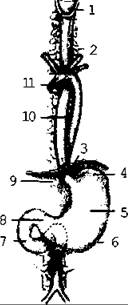
Fig. 7.10. The esophagus and stomach
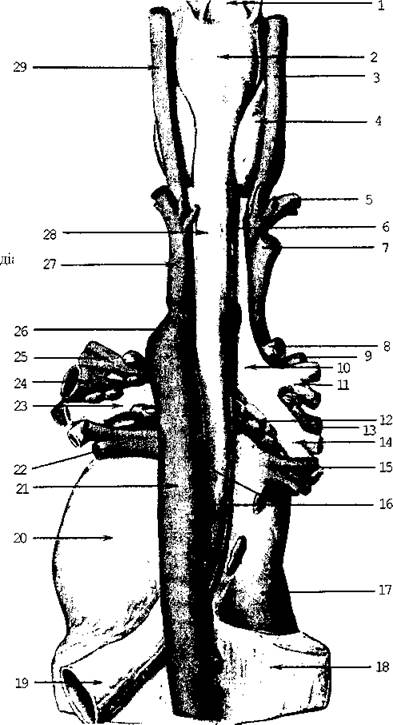
Fig. 7.11. Topography of the esophagus
The wall of the esophagus consists of a mucous membrane forming longitudinal folds, a submucosa, and a muscular coat (composed of an outer longitudinal layer and an inner circular layer). The Muscles in the upper third of the esophagus are striated, whereas those in the lower third are smooth. Externally, the esophagus is covered by loose Connective Tissue—the adventitia—which allows its cross-sectional diameter to change during the passage of food boluses of varying sizes.
Last update: 08/08/2026
Editorial and Educational Adaptation: This material has been compiled based on the primary/original source text. The project team performed an editorial review, corrected technical inaccuracies, structured sections, and adapted the content for an educational format.
What was processed:
- elimination of formatting defects (OCR errors, structural breaks, corrupted characters);
- editorial organization of content;
- standardization of terminology in accordance with academic sources;
- verification of factual statements against the original source text.
All mentions of the author, publication year, and origin of the primary text have been preserved in accordance with the source.