ATLAS OF HUMAN ANATOMY - G.L. Bilich - 2014
Muscular System
MUSCLES AND FASCIA OF THE LOWER LIMB
Serving as Organs of support and locomotion, the human lower limbs possess the most powerful musculature, accounting for over 50% of an adult's total Muscle mass. In accordance with the anatomical division of the limb, the Muscles are grouped into those of the Pelvic Girdle and those of the free lower limb (thigh, leg, and FOOT) (Figs. 354, 355, Table 47). Among all lower limb muscles, the most highly developed in humans are the gluteus maximus (which acts as a hip extensor and maintains upright posture); the quadriceps femoris (which extends the leg, flexes the thigh, and maintains upright posture); and the powerful triceps surae of the leg (which performs plantarflexion of the foot).
Class="center">
Fig. 354. Muscles of the right lower limb, anterior view:
1 —- Superior extensor retinaculum; 2 — Fibularis brevis; Peroneus brevis; 3 — Tibialis anterior; 4 — Fibularis longus; Peroneus longus; 5 — Quadriceps femoris; 6 — Adductor longus; 7 — Pectineus; 8 — Tensor fasciae latac; Tensor of fascia lata; 9 — Sartorius; 10 — Iliopsoas; 11 — Gracilis; 12— Gastrocnemius, medial HEAD; 13 — Soleus; 14 — Extensor digitorum longus; 15 — Extensor hallucis longus; Tendon; 16 — Inferior extensor retinaculum
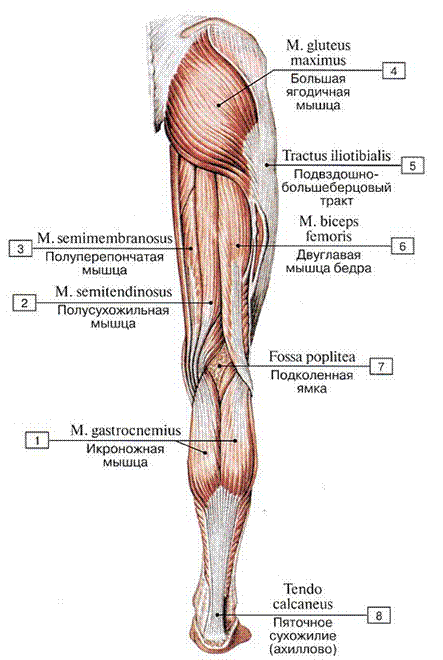
Fig. 355. Muscles of the right lower limb, posterior view:
1 — Gastrocnemius; 2 — Semitendinosus; 3 — Semimembranosus; 4 — Gluteus maximus; 5 — Iliotibial tract; 6 — Biceps femoris; 7 — Popliteal fossa; 8 — Calcaneal tendon
Last update: 08/08/2026
Editorial and Educational Adaptation: This material has been compiled based on the primary/original source text. The project team performed an editorial review, corrected technical inaccuracies, structured sections, and adapted the content for an educational format.
What was processed:
- elimination of formatting defects (OCR errors, structural breaks, corrupted characters);
- editorial organization of content;
- standardization of terminology in accordance with academic sources;
- verification of factual statements against the original source text.
All mentions of the author, publication year, and origin of the primary text have been preserved in accordance with the source.