Basics of Evolution - Korzh O.P. - 2006
Part II. MACROEVOLUTION
Chapter 15. Megaevolution
15.1. The Ecosystem Concept
Any area of the Earth's surface can only be inhabited by a complex of species. The isolated existence of a single species quickly impairs the conditions for its functioning: an increase in biomass depletes nutrient resources, without which the species begins to die off. Even when new resources are added, a decrease in biomass is caused by the accumulation of Metabolic waste products. Each species modifies its environment in a direction unfavorable to itself, which is compensated for by other organisms living alongside it.
Therefore, all living things are integrated into ecosystems—biological communities together with their physical environment. An ecosystem acts as the fundamental unit of the biosphere. It is a dimensionless concept with no fixed territorial boundaries. Transitional zones, known as ecotones, exist between different ecosystems. Ecosystems can be stable, maintaining characteristic features over a long period, or short-lived.
The long-term existence of ecosystems as a single entity requires certain conditions—for trapping and releasing energy, and for cycling matter. The most crucial feature of ecosystems is their formation by living organisms with diverse Types of Nutrition. The following set of characteristics is used to describe ecosystems:
1) the species composition of living organisms typical of a given ecosystem;
2) The ratio of organisms with Different types of nutrition;
3) the volumes of Primary and secondary production within the ecosystem;
4) the intensity of Energy Flow and The rate of matter cycling;
5) the characteristics of abiotic conditions, resource status, etc.
Ecosystems began to form at the very dawn of life. Autotrophs synthesize organic substances, while heterotrophs consume and break them down (forming the so-called ecological triad of producers-consumers-decomposers). Thus, a cycle of matter is established among the organisms of the ecosystem (Fig. 15.1). The biotic and abiotic PARTS OF THE ecosystem are linked by a continuous exchange of material, driven by solar energy.
Class="center">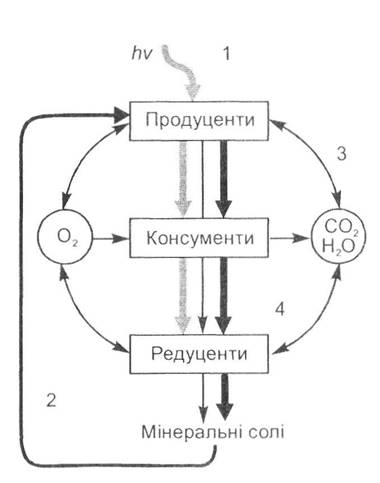
Fig. 15.1. Ecosystem Structure (according to A.K. Brodsky, 2000):
1 energy flow; 2 - solid matter cycle; 3 - gaseous matter cycle; 4 - activity of anaerobic Bacteria
Every ecosystem comprises two main components: the autotrophic component, which utilizes simple inorganic substances through the fixation of light energy and builds organic matter; and the heterotrophic component, which relies on the utilization and decomposition of organic matter (except in ecosystems based exclusively on detrital food chains). The organisms representing these components may be segregated either in space (stratification) or in time (delay in Processing and its redirection to the decomposer chain).
The structure and functioning of ecosystems take into account all forms of activity of their constituent organisms, their interactions with one another, and their interactions with the physical environment. Ecosystem properties are shaped by the life activities of the animals and plants that comprise them (though plants live solely for themselves). The living components of ecosystems form a biocenosis (community). The integrity of a biocenosis is maintained by several mechanisms, the two most important being:
1) the Selection of species into any biocenosis based on the shared environmental requirements of the organisms;
2) the evolution of adaptations in animals and plants for coexistence, which creates interdependence among different species. These ensure a regular and predictable set of species within biocenoses.
An ecosystem possesses certain emergent properties, meaning its characteristics cannot be reduced to the sum of its parts. It maintains stability amidst relative environmental constancy and is capable of various changes due to environmental fluctuations or internal dynamics. The capacity of an ecosystem for self-maintenance and self-regulation is called Homeostasis. It is rooted in THE PRINCIPLE OF feedback (which can be positive or negative). Negative feedback is more critical for maintaining homeostasis, as it regulates processes such as nutrient accumulation and release. Thus, the interaction of material cycles and energy flows generates a self-correcting homeostasis, the maintenance of which is possible only within certain limits.
Homeostasis involves not only organisms and their metabolic products, but also the inorganic realm. The life activities of organisms continuously drive Physical and Chemical changes in inert matter, enriching their habitat with novel substances as well. The rate of biogenic change exceeds geological processes at least fourfold. Substances stored by organisms enhance the stabilizing effect of ecosystems.
The most crucial integrating factor in The formation of a biocenosis can be considered the trophic interactions arising among its components. No Organism can survive without specific nutritional resources; in turn, it serves as a potential resource for a whole range of other organisms (herbivores, predators, decomposers, etc.). The complex structure of a biocenosis is one of the most important prerequisites for maintaining its relative stability. However, scientists have concluded that the decisive factor for the sustainability of specific ecosystems is not the sheer number of constituent species, but rather their ecological traits.
Last update: 07/08/2026
Editorial and Educational Adaptation: This material has been compiled based on the primary/original source text. The project team performed an editorial review, corrected technical inaccuracies, structured sections, and adapted the content for an educational format.
What was processed:
- elimination of formatting defects (OCR errors, structural breaks, corrupted characters);
- editorial organization of content;
- standardization of terminology in accordance with academic sources;
- verification of factual statements against the original source text.
All mentions of the author, publication year, and origin of the primary text have been preserved in accordance with the source.