Basics of Evolution - Korzh O.P. - 2006
Part II. MACROEVOLUTION
Chapter 14. Progressive Evolution
14.3. Biological Progress
METABOLISM/2.html">THE CONCEPT OF this form was first developed by O.M. Severtsov as a counterpart to morphophysiological progress. According to the scientist, the key differences between these two forms are as follows: biological progress does not necessarily require corresponding progressive Changes in the structures and Organization of organisms, whereas morphophysiological progress involves structural improvement and does not necessarily lead to a dominant position for the respective groups of organisms.
When a particular group develops traits that give it an advantage in the Struggle for Existence, it may eventually significantly expand its living area and achieve a dominant position: this marks the beginning of the group's flourishing, which can be defined as biological progress.
The Main criteria for this form of progress are an increase in the population size of the group, an expansion of its geographic range, and The Emergence of intragroup differentiation (daughter forms). Naturally, these criteria for biological progress have certain limitations: it is impractical to compare the population sizes of whales or hippos (or even the most common mammals) with any insects, let alone single-celled organisms. For instance, about 99% of the biosphere's biomass is accounted for by plants, while invertebrates make up 97% to 99% of animal biomass. Therefore, all three criteria should be applied relative to closely related species or groups of species.
One of the features of biological progress is its vector nature: a specific group undergoes different stages over time, which can be characterized as states of biological progress, stabilization, and regression. The Essence of these transformations is that as a new group forms, its population size begins to grow, new territories are subsequently colonized (range expansion), and later daughter forms emerge (new species within a genus, genera within a family, etc.). This condition can be classified as biological progress. However, such an increase in potential cannot continue indefinitely, and sooner or later, having exhausted its biotic potential, the group transitions to a state of stabilization (the so-called conservative form with more or less defined range boundaries, clearly established species, and a relatively stable population size). The duration of this state depends on the environment remaining relatively stable. The existence of phylogenetic relicts confirms that certain species and forms can persist for quite a long time without fundamental new transformations. When environmental conditions change, conservative forms that have lost their necessary adaptive plasticity enter a path of regression, which manifests as a restricted range, a sharp decline in population numbers, and the disappearance of many forms. Therefore, it is customary to distinguish between neo- and paleoendemics, which correspond to the initial and final states of existence of the respective Organism groups.
Thus, biological progress is characteristic of almost all groups of organisms, but it is a temporary phenomenon and must inevitably transition into a phase of stabilization or culminate in regressive development and the eventual extinction of those organisms. The fact that all modern species account for no more than 2—5% of the total number that ever existed on Earth further reinforces this idea. Today, humanity as a biological species is on the path of biological progress (its range is expanding, population numbers are growing, and the intermingling of different races contributes to greater intrapopulation diversity). At the same time, ecological and other challenges point to a trend and the possibility of a rapid transition from biological progress directly to regressive development, bypassing stabilization.
Biological progress can be achieved through all three Main Pathways of organism development: via aromorphoses, the evolution of idioadaptive adaptations, and even through general degeneration (Fig. 13.8). Examples of aromorphoses were discussed earlier (the respective group thus embarks on a path of biological progress, which is typically characteristic of rather large taxonomic units at the level of phyla, classes, and sometimes orders). For instance, due to The formation of a cuticle, metabolic features, and other adaptations, insects have become modern dominant forms and humanity's primary biological competitors—they are distributed almost globally, boast the highest number of species, and exhibit large population sizes across most species.
Minor organizational transformations of an idioadaptive nature can also contribute to the Progressive development of organisms. This process is frequently accompanied by the specialization of the respective forms. For example, geckos exhibit limb specialization (widening of the toes, development of specialized adhesive apparatuses) for locomotion on vertical surfaces (Fig. 14.1). At the same time, the group may retain A large number of relatively primitive traits (geckos retain amphicoelous—biconcave vertebrae, a primitive state of the integument, and certain other features), which does not prevent them from following the path of biological progress. There are numerous examples of this type of progressive development, as this pathway is characteristic of most small taxonomic groups.
Class="center">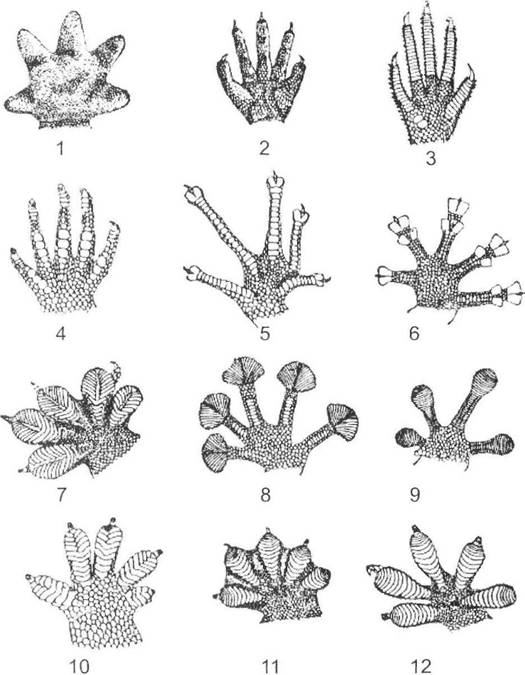
Fig. 14.1. Forelimbs of certain gecko species (after A.G. Bannikov, 1985):
1 - Chondrodactylus angulifer; 2 - Nephrurus asper; 3 - Crossobamon eversmanni; 4 - Cyrtodactylus laevigatas; 5 - Phyllodactilus slamensis; 6 - Calodactulodes aureus; 7 - Gerhyra mutilata; 8 - Ptyodactylus homolepis; 9 - Phelsuma andamanense; 10 - Lepidodactylus guppi; 11 - Ptychozoon; 12 - Gekko gecko
In the event of a significant simplification of living conditions, which is characteristic of parasitic, sessile, and certain other forms, extensive degeneration of entire Organ Systems can occur alongside the progressive development of specific vital structures. These transformations can be explained as follows: nothing in biology comes without a cost; the formation of any organ requires the expenditure of organic matter and energy. If certain structures prove to be non-essential, the saved resources are better channeled into The Development of vital components. For parasites or sessile forms, this primarily applies to the Reproductive System, as high fecundity becomes a paramount prerequisite for the normal development of their offspring, ensuring their dispersal and the completion of complex life cycles. Such a general simplification of organization facilitates the biological progress of these forms within their specific environmental conditions.
Some specialists (L.Sh. Davitashvili, G.A. Schmidt) consider the concept of biological progress to be redundant, as it is equivalent to a state of prosperity for the respective group. While agreeing that redundant terms introduce a certain confusion into the understanding of related processes, we believe it is useful to be familiar with the concepts surrounding biological progress. In the future, a unified theory of progressive evolution may well emerge.
Last update: 07/08/2026
Editorial and Educational Adaptation: This material has been compiled based on the primary/original source text. The project team performed an editorial review, corrected technical inaccuracies, structured sections, and adapted the content for an educational format.
What was processed:
- elimination of formatting defects (OCR errors, structural breaks, corrupted characters);
- editorial organization of content;
- standardization of terminology in accordance with academic sources;
- verification of factual statements against the original source text.
All mentions of the author, publication year, and origin of the primary text have been preserved in accordance with the source.