BOTANY VOLUME 4 - ECOLOGY - 2007
12. FUNDAMENTALS OF PLANT ECOLOGY
Scientific ecology studies the interactions between organisms and their biotic and abiotic environment. It spans all Levels of biological Organization, from individual organisms to the entire biosphere. Consequently, research directions and specialized disciplines are diverse (see 12.6).
Ecology is a relatively young science; therefore, it continues to refine its conceptual frameworks. Like physics, these are rooted in several fundamental, widely accepted principles established by such scientists as T.R. Malthus, C. Darwin, G.F. Gause, R.L. Lindeman, and R.M. May. P. Grime formulated the following Conclusions:
✵ every existing undisturbed population of individuals reaches resource limitation;
✵ within a shared habitat, one species will replace another if the latter exhibits more abundant fructification or lower mortality;
✵ it follows that two species can coexist over the long term only if they occupy different functional niches (see below);
✵ plant cover density affects populations or species assemblages in such a way that the number of individuals remains stable or undergoes cyclic fluctuations;
✵ available energy decreases along the food chain.
A species may be replaced by a genotype, or in certain cases, by a higher-level taxon (e.g., a genus) or a group of functionally similar species. These "fundamental principles of ecology" are significant only over long observation periods spanning multiple generations. Resource and space limitations run like a red thread through all these premises. Disturbance can disrupt the close connection between resource availability and the spatial distribution of individuals.
For plants, METABOLISM/2.html">THE CONCEPT OF a resource encompasses not only nutrients and Water, but also sunlight, and even the presence of symbionts and pollinators. There is no consensus on whether Temperature (thermal energy), space (site), and time (developmental niches, such as the onset and duration of flowering) should be classified as resources. An ecological niche corresponds to a specific combination of resource supply and its depletion (and not only in spatial terms). The central theme of the aforementioned premises is that limitation is an all-encompassing phenomenon of life—the cornerstone of ecology, economy, and resource budgeting.
12.1. Limitation, Success, and Optimum
The concept of limitation implies "too little" (from Latin limes, meaning boundary). Too little of what? Too little for what? As for the first question, it is self-evident. In the desert, there is too little water; beneath the forest canopy, too little light (competition); in a bog, too little nitrogen available to plants. Less obvious limitations are revealed through comparative experiments and analyses. Interdependent limitations of multiple factors are frequently observed (for instance, soil dryness impairs nutrient uptake). However, answering the second question—limitation for what?—is more problematic. Here, There are two distinct foundational starting points:
✵ for biomass production, i.e., growth, regardless of which plant species produce it;
✵ for the continued persistence of a species within its habitat.
If we take the nitrogen Fertilization of a species-rich natural meadow as an example, resource limitation with respect to biomass production will decrease, and the hay yield will increase. However, repeating this Treatment over several years will cause the plant species initially considered limited to disappear, with few exceptions, and the hay will consist largely of new species. For the persistence of a greater number of species in that space, nitrogen supply was likely not limited; rather, the previous restriction on biomass production due to nitrogen scarcity was actually a prerequisite for the survival of those species (see 13.8).
Borrowed from agricultural sciences, the biomass production-oriented concept of limitation is of little use to ecology. With regard to maximum biomass increment, almost all plant communities are limited by the deficit of some resource. Conversely, when examining the habitat-specific species composition, or biodiversity, the concept of "limitation" becomes problematic. As a rule, it is precisely the growth-limiting scarcity of a resource that merely promotes the growth of certain species. Plant growth in dry grasslands is periodically limited by drought. If these grasslands were irrigated, however, their characteristic species would quickly disappear. They are "dry-condition" grasslands because their constituent species are drought-tolerant and adapted to this habitat (see 13.8). Long-term persistence signifies fitness, wherein a taxon (in most cases a species) remains permanently represented in a given area and reproduces normal (and fertile) offspring. This may—but does not necessarily—coincide with a high individual biomass. Due to their modular Structure, plants are significantly more plastic in this regard than animals (the vast majority of which have a unitary structure). Only those species whose persistence is unadapted to a particular habitat are limited in their survival. The species-specific conditions for success and the pathways (mechanisms) of achieving it represent an important field of study in ecological botany.
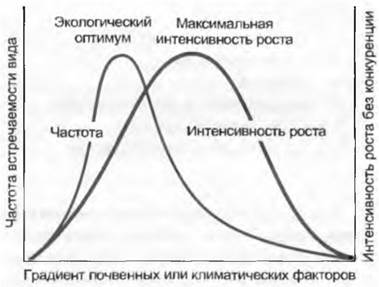
In a similar way, the agronomic and ecological concepts of the optimum differ. For each plant species, one can determine the environmental conditions under which the plant grows most successfully and achieves an optimal yield in terms of productivity. However, this reveals nothing about its success in the wild, within habitats featuring combinations of various factors. As a rule, other species exist that cope even better with these conditions or, for example, lack phytophages there. At least as importantly, optimal growth (in the aforementioned sense of maximum growth) is frequently accompanied by a reduced resistance to disturbances (mechanical strength), stress, and often even pathogens. Environmental optimality within a habitat is the result of interactions among a multitude of abiotic and biotic factors, and this cannot be replicated in a single-factor laboratory experiment. The ecological optimum reflects the outcome of an optimal balance among many life Functions (rather than mere biomass production). Its presence can be gauged primarily by the relative Abundance (frequency) of a species, with the historical factor playing a major role (e.g., past disturbances), and the degree of community maturity (early vs. late successional stage, see 14.2.4.2) also exerting a strong influence. When a species is widely distributed, approximations are possible (chorology, see 14.2). However, one cannot assume that where a species reaches maximum abundance, individual environmental factors have optimal values for its biomass production (Fig. 12.1). For instance, the Scots pine (Pinus sylvestris) in Western Europe can be abundant on both very acidic (bog) and mildly basic (calcareous) soils, yet it would grow much better on mildly acidic soils if it were not outcompeted there by beech or oak.
Fig. 12.1. Natural occurrence and maximum growth intensity of isolated individuals of a single plant species along environmental gradients.
Class="center">The difference is clearly visible between the peak frequency of occurrence of a species (ecological optimum) and the conditions under which maximum growth intensity is achieved in experiments without competition from other species. This discrepancy is explained by the interaction of abiotic and biotic factors and disturbances in the natural habitat (competition, herbivores, pathogens, symbionts, fire, mechanical disturbance) or has historical causes (migration rates). Often, under physiologically optimal growth conditions for one species, other species are more competitive because they cope better with a particular environmental factor or arrived there first. The frequency curve may be multi-peaked, extremely narrow, or very broad.
Last update: 07/08/2026
Editorial and Educational Adaptation: This material has been compiled based on the primary/original source text. The project team performed an editorial review, corrected technical inaccuracies, structured sections, and adapted the content for an educational format.
What was processed:
- elimination of formatting defects (OCR errors, structural breaks, corrupted characters);
- editorial organization of content;
- standardization of terminology in accordance with academic sources;
- verification of factual statements against the original source text.
All mentions of the author, publication year, and origin of the primary text have been preserved in accordance with the source.