PLANT BIOPHYSICS - Y. I. Posudin - 2004
II. TRANSPORT PROCESSES IN THE SOIL-PLANT-ATMOSPHERE SYSTEM
9. ENERGY TRANSPORT
9.1. RADIATION TRANSPORT
Class="center">9.1.1. Natural radiation
Parameters of solar radiation. The Sun is the primary external source of light and energy for the Earth and its atmosphere, making life on our planet possible. The Sun is an incandescent sphere with a radius of 6.96 · 108 m and a mass of 1.991 · 1030 kg. The distance between the Sun and the Earth is 1.496 · 1011 m. The Elemental Composition of the Sun is hydrogen (64%), helium (32%), and a mixture of heavy elements (4%). The Temperature of the Sun is 2 · 107 °C at the core and 6,000 °C at the surface. Such high temperatures drive The ionization of molecules in the solar medium and trigger nuclear reactions. These processes are accompanied by the release of a vast amount of energy. The annual solar energy received by the Earth is 5.5 · 1024 J, with a power output of 1.5 · 1018 kW per hour. The Sun can be modeled as a blackbody with a temperature of 6,000 K.
The spectral range of solar radiation spans from 200 to 5,000 nm, with the emission maximum occurring at 500 nm. THE SPECTRUM OF solar radiation reaching the Earth's surface comprises ultraviolet (200-400 nm), visible (400-700 nm), and infrared (>700 nm) regions. The ultraviolet, visible, and infrared parts account for 5%, 35%, and 60% of solar radiation, respectively. The solar spectrum outside the atmosphere and at the Earth's surface is shown in Fig. 9.1. It can be seen that the extraterrestrial solar spectrum closely resembles that of a blackbody at 6,000 K with a peak around 0.5 µm. Upon passing through the Earth's atmosphere, solar radiation is significantly absorbed at specific wavelengths (by ozone in the ultraviolet region, and by Water vapor and carbon dioxide in the infrared region). The character of the solar spectrum is also influenced by light scattering from small air molecules (Rayleigh scattering) and large dust, smoke, and aerosol particles (Mie scattering), as well as solar elevation, cloud cover, and atmospheric composition.
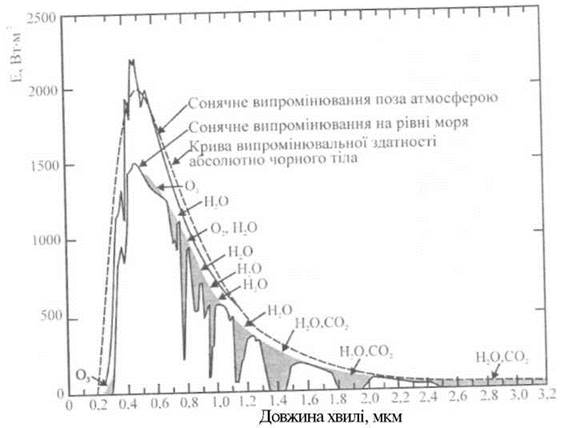
Fig. 9.1. Spectrum of solar radiation outside the atmosphere and at the Earth's surface.
Solar radiation is distributed as follows: about 17% is absorbed by clouds, water vapor, and carbon dioxide, which directly contributes to atmospheric heating; about 30% is reflected by clouds, atmospheric gases, and particles; and about 53% reaches the Earth's surface, two-thirds of which as direct sunlight and one-third as diffuse light.
The radiative Properties of the Sun are described by the equation:

where Eс↓ is the total global solar irradiance of the Earth's surface, while Eccosθ and Eд↓ are the irradiance of the Earth's surface due to direct and diffuse solar radiation, respectively.
The average values of total and diffuse solar irradiance are: Eс↓ = 900 W·m-2, Eд↓ = 200 W·m-2 (clear sky); Eс↓ = 800 W·m-2, Eд↓ = 350 W·m-2 (partly cloudy sky with cumulus clouds); Eс↓ = Eд↓ = 300 W·m-2 (overcast sky). The radiative properties of the Sun remain remarkably constant. The intensity of solar radiation at noon for a short period in clear weather is 1,368 W·m-2 (the solar constant). Taking into account the total area of the Earth's surface, the average intensity of solar radiation is 342 W·m-2. In Ukraine, the intensity of solar radiation varies from 115-145 W·m-2 in the Polissia region to 185-215 W·m-2 in Crimea.
Atmospheric radiation. The Earth's surface is exposed to longwave atmospheric radiation, which is primarily governed by gases such as water vapor, carbon dioxide, and ozone. These components absorb and emit radiation within specific bands: water vapor at 5-7 µm and at wavelengths exceeding 17 µm; carbon dioxide around 4.5 µm and at wavelengths greater than 13.5 µm; and ozone around 9.6 µm. In addition, atmospheric aerosols contribute to thermal radiation. Overall, the atmospheric emission spectrum spans the range of 5-100 µm, and the radiant emittance of the atmosphere is determined by the expression:

where σ is the Stefan-Boltzmann constant (5.67 · 10-8 W·m-2·K-4), and ТА is the temperature of a hypothetical blackbody used to model the atmosphere.
In practice, all natural bodies at ambient temperatures can be treated as gray bodies characterized by an emissivity ε. The radiant emittance of a gray body is defined as M = εσТ4. Empirical formulas are convenient for estimating the emissivity of a clear sky; the first of these is expressed as:

where e is the water vapor pressure (kPa) at a height of one to two meters, and Тn is the air temperature (K).
Indeed, atmospheric thermal radiation depends on the concentration of water vapor within the lower few kilometers, especially within the first few hundred meters. The second formula is also based on the correlation between water vapor pressure and temperature:

The emissivity of a cloudy sky is estimated by the expression:

where c is the fraction of the sky covered by clouds.
When c = 0 (clear sky), εx = εn; when c = 1 (overcast sky), εх = 0,84 + 0,16εn;
Due to the atmospheric radiant emittance, the Earth's surface is irradiated; the irradiance of the Earth's surface is equal to the radiant emittance of the atmosphere (ЕА↓ = МА↑).
Example. Determine the radiant emittance of a clear sky if the air temperature is 20 °C.
Solution. Using the Stefan-Boltzmann law, we find the blackbody radiant emittance.

Let us determine the emissivity of a clear sky using equation (9.4):

Hence, the radiant emittance of a clear sky will be:

Radiation of the Earth's surface. The radiant emittance of the Earth's surface is determined by the expression:

where ε is the emissivity of the Earth's surface (Table 9.1).
The Earth's surface acts as a grey body with a temperature of 288 K. The spectral radiation range is 4-50 µm with a peak at 10 µm. The radiation of the Earth's surface is almost entirely absorbed by the atmosphere (specifically by water vapor, carbon dioxide, and ozone), except for specific spectral regions — the so-called "atmospheric windows" — through which radiation can escape into space. Thus, for an emissivity of the Earth's surface of 0.95 and a temperature of 288 K, the radiant emittance of the Earth's surface is M3 = 371 W·m-2.
Example. Determine the radiant emittance of moist soil if the air temperature is 20 °C.
Solution. Using the data from Table 8.3 (ε = 0.97 for moist soil) and formula (8.25), we find the radiant emittance of moist soil.

9.1.2. Radiation Balance of a Leaf
Let us consider the potential Pathways of Energy supply to the leaf surface (Fig. 9.2). The upper surface of the leaf receives direct and diffuse (scattered by clouds and atmospheric particles) solar radiation (Ес↓) in the visible spectrum, as well as longwave atmospheric radiation (σТА4). The lower surface of the leaf receives radiation reflected from the Earth's surface, tree trunks, branches, other leaves, etc. (а3Ес↓) and longwave radiation from the Earth's surface (ε3σТЗ4).

Fig. 9.2. Potential pathways of energy supply to the leaf surface: 1 - direct solar radiation, 2 - cloud-scattered solar radiation, 3 - reflected solar radiation, 4 - cloud-scattered solar radiation reflected from the Earth's surface, 5 - longwave atmospheric radiation, 6 - longwave radiation from the Earth's surface, 7 - longwave radiation emitted into the atmosphere, 8 - longwave radiation emitted into the environment, 9 - solar radiation scattered by atmospheric particles, 10 - atmospheric radiation reflected from the Earth's surface.
Reflected radiation can account for 10-30% of the total radiation reaching the leaf surface. The fraction of visible spectrum radiation reflected from a natural surface is called albedo. Numerical albedo values depend on the type of surface (Table 9.1).
Table 9.1. Values of albedo a and emissivity ε of natural surfaces
Surface type |
Additional characteristics |
Albedo a |
Emissivity ε |
Water |
small zenith angles large zenith angles |
0,03-0,10 0,10-0,50 |
0,92-0,90 0,92-0,97 |
Snow |
old fresh |
0,40-0,70 0,45-0,95 |
0,82-0,89 0,90-0,99 |
Ice |
sea mountain |
0,30-0,40 0,20-0,40 |
0,92-0,97 - |
Sand |
dry moist |
0,35-0,45 0,20-0,30 |
0,84-0,90 0,91-0,95 |
Soil |
dry moist moist uncultivated lands |
0,20-0,35 0,10-0,20 0,05-0,07 |
0,95 0,97 - |
Artificial surfaces |
concrete asphalt |
0,17-0,27 0,05-0,10 |
0,71-0,88 0,88-0,95 |
Agricultural fields |
meadows crops orchards |
0,16-0,26 0,10-0,25 0,15-0,20 |
0,90-0,95 0,90-0,99 0,90-0,95 |
Forests |
deciduous deciduous leafless coniferous |
0,20 0,10-0,20 0,05-0,15 |
0,98 0,97-0,98 0,97-0,99 |
Energy losses by the upper surface of the leaf are determined by the processes of reflection  and transmission
  of visible solar radiation, reflection of radiation coming from the Earth's surface
  , thermal infrared radiation of the leaf
  , re-emission of atmospheric radiation
 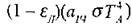 and radiation of the Earth's surface
  . Here: Ес↓ is the total solar irradiance (direct and diffuse) of the leaf surface, а3 is the albedo of the Earth's surface, ал is the leaf absorptance, τл is the leaf transmittance, аіч is the leaf absorptivity characterizing the fraction of incident radiation absorbed by the leaf, σ is the Stefan-Boltzmann constant, ТА is the atmospheric temperature, ε3 is the soil emissivity, and Т3 is the soil temperature.
Taking into account the actual values of parameters characterizing the leaf radiation balance, namely: а3 = 0,15, ал = τл = 0,2, εз = 0,95, εл = 0,97, the leaf radiation balance equation can be expressed as:

Last update: 07/08/2026
Editorial and Educational Adaptation: This material has been compiled based on the primary/original source text. The project team performed an editorial review, corrected technical inaccuracies, structured sections, and adapted the content for an educational format.
What was processed:
- elimination of formatting defects (OCR errors, structural breaks, corrupted characters);
- editorial organization of content;
- standardization of terminology in accordance with academic sources;
- verification of factual statements against the original source text.
All mentions of the author, publication year, and origin of the primary text have been preserved in accordance with the source.