PLANT ADAPTATION TO ANTHROPOGENIC FACTORS - 2017
4. EFFECT OF IONIZING RADIATION ON PLANT ORGANISMS
4.2. Doses of Ionizing Radiation
Plant exposure to ionizing radiation in an experiment is achieved by placing the plant for a specified period of time into a radiation field—the space through which radiation propagates. To characterize a radiation field, one must know how many particles or quanta, with what energy and direction, enter each point of the medium at a given time. Because the radiation field is usually created in air or another medium where the quanta or charged radiation particles interact with substance atoms, both the initially set direction of motion of the particles and quanta and their energy change. Therefore, a complete description of a radiation field is a rather complex task; thus, integral characteristics are more commonly used that do not account for particle direction, restricting the values to the spatial distribution of energy and the radiation flux.
The energetic characteristic of a radiation field is obtained by assessing the potential effect of radiation interaction with matter at each of its points. Among the integral flux characteristics, flux density and particle fluence—the integral of the particle flux over a given time interval—are utilized.
As an integral energetic characteristic of a radiation field that reflects the probability of a specific radiation interaction effect occurring with matter at a given field point, the exposure dose of radiation is adopted. It characterizes the quality of the radiation field regardless of whether any specific object is irradiated within it. The exposure dose is a measure of the ionizing effect of radiation (its unit is coulombs per kilogram (C · kg-1)).
1 C · kg-1 is the exposure dose of X-ray or γ-radiation that produces ions carrying an electrical charge of either sign equal to 1 C in dry atmospheric air. For a long time, the non-system unit of exposure dose—the roentgen (1 P = 2.58 · 10-4 C · kg-1)—has been widely used and remains in use today.
The rate of increase of the exposure dose in a radiation field is called the exposure dose rate (Pexp, with the unit C · kg-1 · s-1).
In the earliest works on the effects of X-rays, the exposure dose was characterized by the duration of exposure, the voltage applied to the X-ray tube, and the thickness of the filter through which the X-rays passed. These data allowed only an approximate estimation of the dose in roentgens.
For a time, the so-called "erythema dose" was in use, defined as the quantity of X-rays that causes Skin reddening, or erythema. The transition from the erythema dose to the exposure dose is conventional in nature.
Absorbed dose of radiation. Since The Effect of irradiation is determined by the energy absorbed by an object placed in a radiation field, the absorbed dose is used as the energetic characteristic of irradiation. It pertains not to the radiation field, but to the irradiated object. The absorbed dose reflects the energy of ionizing radiation absorbed by the irradiated object, calculated per unit of its mass.
The unit of absorbed dose is the dose at which 1 J of energy is absorbed by 1 kg of the irradiated material. The name of this unit is the gray (Gy). The rate of accumulation of the absorbed dose is called the absorbed dose rate (unit Pabs — Gy · s-1).
To calculate the absorbed dose from the exposure dose, the following relation is used:
Class="center">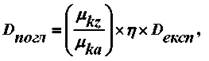
where μkz is the energy transfer coefficient of radiation to a substance with a given effective atomic number; μka is the energy transfer coefficient of air; η is the energy equivalent of the exposure dose, which depends on the energy spectrum of the radiation.
Since the biological effect of radiation depends not only on the absorbed dose but also on radiation quality and its relative biological effectiveness, METABOLISM/2.html">THE CONCEPT OF equivalent dose of irradiation was introduced. It is defined as follows: the dose of a given type of radiation that produces the same biological effect on a given biological object as a 1 R dose constitutes 1 roentgen equivalent man—1 rem. This unit of equivalent dose was used until the Introduction of the new SI unit, the sievert (Sv). 1 Sv is equal to the dose of a given type of radiation that produces a biological effect identical to that caused by 1 Gy of X-rays or γ-rays.
The radiation field can be created by sources located outside the irradiated object as well as within the object itself. For example, irradiation of plant Tissues can be carried out both by external radiation sources and by inserting a needle containing a particular radiation source into them. Special conditions are created when radionuclides enter the tissue and concentrate in individual Cells or their Organelles, such as 3H-thymidine in the DNA of Cell nuclei. In such cases, the irradiation dose and dose rate must be calculated based on The activity of the incorporated radionuclides, the energy of their radiation, and the radiation absorption coefficient.
To register doses and dose rates of ionizing radiation, dosimeters of various designs are used, which most frequently display the exposure dose. To measure absorbed doses in biological objects, tissue-equivalent radiation detectors are employed.
Last update: 07/08/2026
Editorial and Educational Adaptation: This material has been compiled based on the primary/original source text. The project team performed an editorial review, corrected technical inaccuracies, structured sections, and adapted the content for an educational format.
What was processed:
- elimination of formatting defects (OCR errors, structural breaks, corrupted characters);
- editorial organization of content;
- standardization of terminology in accordance with academic sources;
- verification of factual statements against the original source text.
All mentions of the author, publication year, and origin of the primary text have been preserved in accordance with the source.