BIOLOGY Volume 3 - A Guide to General Biology - 2004
20. EXCRETION AND OSMOREGULATION
20.3. Nitrogen Excretion and Osmoregulation in Selected Animals
20.3.5. General Principles of Water Balance
For Cells to function properly within an animal's body, a steady-state condition of the intracellular fluid must be maintained. The homeostatic exchange of Water between cells, tissue fluid, Lymph, Blood Plasma, and the external environment poses a challenge for both aquatic and terrestrial organisms. Aquatic forms lose or gain water through osmosis across all permeable areas of the body surface, depending on whether their environment is hypotonic or hypertonic. Terrestrial organisms face The Challenge of water loss and employ various mechanisms to maintain a stable water balance, as listed in Table 20.3. This steady state is achieved through a balance between water loss and water intake, as illustrated in Fig. 20.9.
Class="right">Table 20.3. Water conservation mechanisms in two groups of terrestrial animals: insects and mammals
Animals |
Mechanisms and Adaptations |
Insects |
Impermeable cuticle; Trachea and spiracles; Malpighian tubules; uric acid as a nitrogenous waste product; cleidoic eggs |
Mammals (including humans) |
Keratinized Skin and Hair; hypertonic urine containing urea; viviparity; behavioral responses to excess heat; restricted habitat range; physiological tolerance to dehydration |
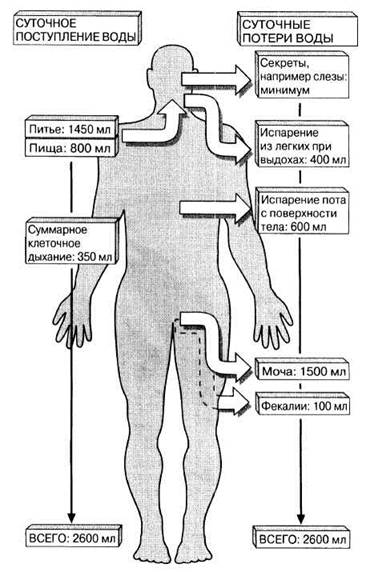
Fig. 20.9. Daily human water balance.
Last update: 06/08/2026
Editorial and Educational Adaptation: This material has been compiled based on the primary/original source text. The project team performed an editorial review, corrected technical inaccuracies, structured sections, and adapted the content for an educational format.
What was processed:
- elimination of formatting defects (OCR errors, structural breaks, corrupted characters);
- editorial organization of content;
- standardization of terminology in accordance with academic sources;
- verification of factual statements against the original source text.
All mentions of the author, publication year, and origin of the primary text have been preserved in accordance with the source.