BIOLOGY Volume 3 - A Textbook of General Biology - 2004
27. MECHANISMS OF SPECIATION
27.3. Selection
Selection can be viewed as a mechanism operating at two interconnected levels: the Organism level and the allele level.
Selection is the process whereby organisms better adapted to their environment in terms of their Morphology, physiology, and behavior survive and reproduce, whereas the less well-adapted either perish or fail to leave offspring. The former pass on their advantageous traits to the next generation, while the latter do not. Selection depends on the presence of phenotypic variation within a population and forms part of the mechanism that ensures a species' adaptation to its environment.
As a population grows, certain environmental factors—such as food for animals and light for plants—become limiting. This leads to resource competition among members of the population. Organisms whose traits give them a competitive edge acquire these resources more easily, survive, and leave offspring. Those lacking such traits are disadvantaged and may die before they can reproduce. The combined effect of limiting environmental factors and population size creates selection pressure, the intensity of which can vary.
Thus, selection is the process that determines which alleles will be passed on to the next generation by virtue of the relative advantages they confer when expressed in the phenotype. Consequently, selection pressure can be seen as a way of increasing or decreasing the frequency of a given allele within the Gene pool, and these shifts in allele frequency can drive evolutionary change.
Major Changes in the genotype arise through the spread of mutant alleles within the gene pool. The extent and rate of selection depend on The Nature of the mutant allele and the strength of its effect on the phenotypic trait in question. If an allele is dominant, it is expressed in the phenotype more frequently, and selection begins to exert positive or negative pressure on it more rapidly. Conversely, if an allele is recessive and remains unexpressed in the heterozygous state—as is typically the case for most Mutations—it is not subjected to selection until it appears in the homozygous state. The probability of such recessive homozygotes appearing rapidly is low, and a new allele may disappear from the gene pool before they arise. A recessive allele that is disadvantageous in a given environment may persist in the population and wait for environmental changes that render it advantageous. These effects will likely manifest first in the heterozygote, and selection will favor its spread through the population, as seen in Sickle-Cell Anemia.
A recessive mutant allele can spread rapidly through a population if its chromosomal locus is linked (in close proximity) to the locus of a functionally important dominant allele that is subject to strong positive selection. Such linkage greatly increases the chances of the mutant allele combining with another mutant allele and becoming homozygous (Fig. 27.1).
Class="center">
Fig. 27.1. Accelerated spread within a population of a mutant allele (a) linked to a dominant allele (B) strongly favored by selection.
The impact of any given mutant allele can vary. Mutations affecting alleles that control vital Functions are most likely to be lethal and are promptly eliminated from the population. Evolutionary changes typically occur through the gradual emergence of mutant alleles that produce small, progressive modifications in phenotypic traits.
There are Three types of selection occurring in natural and artificial populations: stabilizing, directional, and disruptive. These are most easily explained by plotting normal distribution curves for the continuous phenotypic variation observed in natural populations (Fig. 27.2).

Fig. 27.2. Three types of selection operating in populations. 0 — initial position of the matching point between the optimal phenotype and optimal environmental conditions; N — new position of the matching point. Individuals whose traits fall into the hatched areas are disadvantaged and eliminated by selection. Numerals 1–3 indicate The sequence of generations.
27.3.1. Stabilizing Selection
Stabilizing selection occurs when phenotypic traits match optimal environmental conditions and competition is relatively weak. This type of selection operates in all populations, eliminating individuals with extreme trait deviations. For example, there is an optimal wing length for a bird of prey of a certain size and lifestyle in a given environment. Operating via differential reproduction, stabilizing selection will eliminate those birds whose wingspans are greater or smaller than the optimum.
Karn and Penrose studied the correlation between birth weight and postnatal mortality in 13,730 infants born in London between 1935 and 1946. Of these, 614 were stillborn or died within the first month of life. As shown in Fig. 27.3, the optimal birth weight is approximately 3.6 kg. Infants above or below this weight were at a selective disadvantage, and their mortality rate was somewhat higher. The intensity of selection pressure can be calculated from these data.
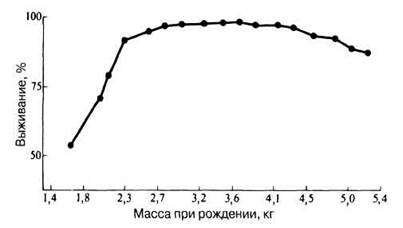
Fig. 27.3. Relationship between birth weight and infant survival. (After M. Karn, L. S. Penrose, Ann. Eugen., 1951, 16, 147-164).
If 614 infants died at birth or in the first month of life, the mortality rate is 4.5%. Even among infants of optimal weight, mortality was 1.8%. Consequently, the selection pressure on a birth weight of 3.6 kg is 4.5% - 1.8% = 2.7%, or 0.027. At a weight of 1.8 kg, mortality was 34%, corresponding to a selection pressure of roughly 30%, or 0.3. It should be noted, however, that thanks to advances in pediatrics since 1946, postnatal mortality has decreased significantly.
Stabilizing selection does not drive evolutionary change; rather, it maintains the phenotypic stability of a population from generation to generation.
27.3.2. Directional Selection
This form of selection arises in response to gradual changes in environmental conditions. Directional selection acts on the range of phenotypes present in a population, exerting a selective pressure that shifts the mean phenotype in one direction or the other. Once an optimal match between the mean phenotype and the new environmental conditions is achieved, stabilizing selection takes over.
Directional selection drives evolutionary change by exerting a pressure on the population that favors an increased frequency of new alleles. Directional selection forms The basis of artificial selection, in which selective breeding of individuals possessing desirable phenotypic traits increases the frequency of those traits in the population (see Section 27.4). In a series of experiments, Falconer selected the heaviest six-week-old mice from a population and allowed them to mate with one another. He did the same with the lightest mice. This selective breeding for body weight resulted in the creation of two populations: one in which weight increased and another in which it decreased (Fig. 27.4). When selection was halted, neither group reverted to its original weight (approximately 22 g). This demonstrates that artificial selection for phenotypic traits resulted in some degree of genotypic selection and the partial loss of certain alleles in both populations. Numerous Examples of classic directional selection have now been studied directly and are described in Section 27.5.

Fig. 27.4. Changes in body mass across successive generations of two mouse populations subjected to selection for this trait. (From D. S. Falconer, J. Genetics, 1953, 51, 470-501.)
27.3.3. Disruptive selection
This is probably the rarest form of selection, but it can play a crucial role in driving evolutionary change. Environmental fluctuations, such as those caused by seasonal shifts and climatic factors, may favor the presence of not just one, but two or more phenotypes within a given population. Selection pressures acting within the population can cause phenotypes to diverge from the population mean toward both extremes. As a result, the population becomes split into two subpopulations. If gene flow between these two subpopulations is disrupted, each may give rise to a new species. In some cases, this form of selection leads to the appearance of several distinct phenotypes within a single population, or polymorphism (from the Greek polýmorphos — manifold), which will be discussed in section 27.5.1. Within a single species, populations with different phenotypes, or ecotypes, may become adapted to specific environmental conditions (section 27.6.2). If a species occupies a very extensive geographical range, the populations inhabiting this range may exhibit local variations in phenotypic traits, becoming intermediate between populations at the range margins. Such a continuous gradient of gradually changing traits across a geographical range is typically a phenotypic response to shifting climatic and/or edaphic (soil) factors and is known as a cline (section 27.6.3).
27.3.4. Intensity of selection pressure
The intensity of selection pressure within a given population varies across both space and time, which may be driven by Changes in external or internal factors. External factors include, notably, an increase in the Abundance of predators or pathogens and competition with other species (interspecific competition) for food and breeding sites (in animals) or for light, Water, and minerals (in plants). Shifts in climate or habitat conditions can generate novel selection pressures. Internal factors, such as a rapid surge in population size, frequently lead to intensified competition for resources (intraspecific competition). As a population grows, the abundance of its parasites and predators also rises; furthermore, in dense populations, the transmission of parasites and diseases between individuals is facilitated. All these factors can alter not only the intensity of selection pressure, but also its direction. Selection favors "novel" phenotypes (and genotypes), while poorly adapted individuals are eliminated. Individuals with non-adaptive extreme phenotypes are the first to be weeded out.
One consequence of increased selection pressure can be the specialization of organisms for a particular lifestyle or a narrower range of environmental conditions. This may well prove detrimental to the long-term fate of the species. Increased uniformity of a species and its reliance on specific conditions heighten the probability of its extinction should those conditions change. The paleontological record abounds with extinct organisms that were highly idiosyncratic and excessively specialized.
27.2. How can knowledge of the selection pressures acting on a particular parasite's lifestyle help in its eradication?
From all the foregoing, it can be seen that elevated selection pressure acts as a conservative mechanism, preserving the phenotype best adapted to current environmental conditions (the optimal phenotype).
A relaxation in the intensity of selection generally has the opposite effect. This can occur in the absence of predators, pathogens, parasites, and competitors, or when environmental conditions improve. Such is the case when a species invades a novel environment. This very scenario is believed to have fostered the diversification of finch species in the Galápagos Islands.
Last update: 06/08/2026
Editorial and Educational Adaptation: This material has been compiled based on the primary/original source text. The project team performed an editorial review, corrected technical inaccuracies, structured sections, and adapted the content for an educational format.
What was processed:
- elimination of formatting defects (OCR errors, structural breaks, corrupted characters);
- editorial organization of content;
- standardization of terminology in accordance with academic sources;
- verification of factual statements against the original source text.
All mentions of the author, publication year, and origin of the primary text have been preserved in accordance with the source.