BIOLOGY Volume 3 - A Guide to General Biology - 2004
26. EVOLUTION, OR THE HISTORY OF LIFE ON EARTH
26.8. Human Evolution
26.8.2. Stone Tools
The increase in Brain size in Homo habilis, the freeing of its hands from locomotion, and their ability to firmly grip and position objects led to the creation of stone tools. Homo habilis (literally, "handy man") probably initially used sticks and pebbles, much like modern chimpanzees and gorillas do. Chimpanzees strip the leaves from a twig before inserting it into a termite mound. Once the termites swarm the twig, they pull it out and feed on the insects. The earliest human-made artifacts were produced by Homo habilis (2 million years ago); these were hand axes, worked stones serving as hammers, and scrapers made of lava or quartz and used, in particular, for skinning carcasses. Later artifacts produced by Homo erectus (1.5 million years ago) required greater skill, such as the handheld, double-edged axe. However, more sophisticated tools made of flint, bone, and wood did not appear until the Upper Paleolithic (35,000 years ago). The physical capability to manufacture tools requires highly precise hand-eye coordination. Such biological activities must rely on the knowledge needed to select appropriate Materials, The ability to share these skills with others, and the know-how to use these tools; all of these fall under the so-called cultural component of Human Development (Fig. 26.20).
Class="center">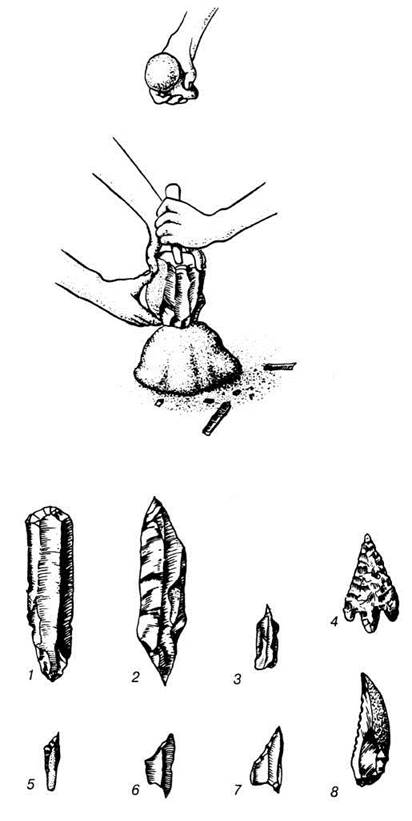
Fig. 26.20. A set of Upper Paleolithic Cro-Magnon tools. By placing a flint core on a stone anvil, long, relatively flat flakes were struck off using a pebble as a hammer and a antler tine as a punch. These flakes were then worked into various tools. 1 — pointed scraper; 2 — burin for engraving; 3 — micro-drill; 4 — dart point; 5–8 — fishhooks. (After S. Tomkins, 1984, The Origins of Mankind, Cambridge University Press.)
Progress in the design, crafting, and use of tools—from the pebbles used 2.5 million years ago to the hand axes that appeared 0.2 million years ago—seems incredibly slow when compared to humanity's technological achievements over the past 100 years. Since 1890, we have gone from the first airplane to sending humans to Mars, overcome most infectious diseases through vaccination and organ transplants, learned to create artificial limbs and Organs, reached unprecedented heights in computer science, expanded the capabilities of our Senses using electron microscopes and radio telescopes, and learned to harness nuclear energy and the potential of biotechnology. These rapid technological advances are not tied to an increase in brain size; rather, they have been made possible by breakthroughs in science and development built upon the knowledge and skills passed down to us by preceding generations. A child raised by animals in complete isolation from humans (like the legendary Tarzan) would possess no greater technical knowledge than our hominid ancestors. Only through upbringing and education—that is, the transmission of culture—are humans capable of the exponential technological progress witnessed over the past century.
Last update: 06/08/2026
Editorial and Educational Adaptation: This material has been compiled based on the primary/original source text. The project team performed an editorial review, corrected technical inaccuracies, structured sections, and adapted the content for an educational format.
What was processed:
- elimination of formatting defects (OCR errors, structural breaks, corrupted characters);
- editorial organization of content;
- standardization of terminology in accordance with academic sources;
- verification of factual statements against the original source text.
All mentions of the author, publication year, and origin of the primary text have been preserved in accordance with the source.