BIOLOGY Volume 2 - A Guide to General Biology - 2004
12. MICROBIOLOGY AND BIOTECHNOLOGY
12.16. Enzyme Technology
12.16.6. Biological Washing Powders
The first commercially successful biological washing powders appeared in the mid-1960s. They contained proteinases (protein-digesting Enzymes) that are particularly effective for removing biological stains such as Blood, grass, and egg. By breaking down the Proteins, the stains disappear. Washing at lower temperatures is permitted, thereby saving energy, although the enzymes used—originally derived from thermophilic (heat-loving) Bacteria—have been selected for their ability to function over a wide Temperature range (10–90 °C with an optimum of around 55 °C). The proteinases in washing powders can also operate under alkaline conditions (pH 9–10) and in the presence of high concentrations of phosphates found in certain detergents. They are particularly useful for pre-washing and soaking laundry, as well as for low-temperature washing. In Western Europe, domestic washing machine use saves up to 25% of energy; a very high proportion compared with other countries.
Shortly after the Introduction of washing powders, health problems began to arise, particularly among workers in detergent manufacturing plants. Some developed allergies to the powders, and after inhaling airborne dust particles of the detergent, they experienced throat irritation and breathing difficulties. As a result, the powders were withdrawn from the US market in the early 1970s, although they continued to be used in Europe. To overcome these problems, the formulation was modified (Fig. 12.27) by incorporating an inert wax coating into the detergent, which prevented direct contact and suppressed dust formation during use. In addition, liquid laundry detergents were developed. Biological washing powders have since returned to the US market, accounting for about 15% of the market by the mid-1990s compared with 85% in Western Europe.
To enhance performance, new enzymes have been added to washing powders. Cellulase breaks down loose Cellulose microfibrils that become detached when cotton fibers are damaged, thereby making cotton fabrics brighter, softer, and smoother. Carbohydrate-digesting enzymes, such as starch-cleaving amylases, are also added. One challenge is that proteinases can digest other added enzymes as well, since they are also proteins! This greatly complicated the Selection of compatible enzymes. More recently, a suitable low-temperature active lipase was discovered in a fungus. The Gene encoding this enzyme was transferred using Genetic Engineering techniques to another fungus that is better suited for growth in fermenters. Lipases break down Lipids, effectively removing grease, oil, and lubricant stains.
Enzymes for washing powders are usually sourced from various species of the genus Bacillus. The enzymes they produce are extracellular, which significantly simplifies their harvesting and purification.
Class="center">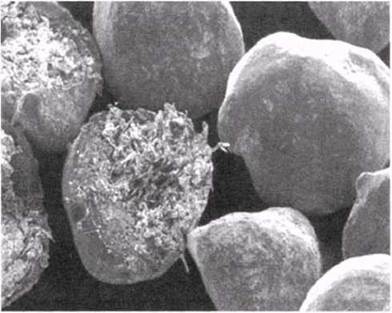
Fig. 12.27. Scanning electron micrograph of biological washing powder particles. Some particles (granules) are broken open, revealing the enzymes inside.
Last update: 06/08/2026
Editorial and Educational Adaptation: This material has been compiled based on the primary/original source text. The project team performed an editorial review, corrected technical inaccuracies, structured sections, and adapted the content for an educational format.
What was processed:
- elimination of formatting defects (OCR errors, structural breaks, corrupted characters);
- editorial organization of content;
- standardization of terminology in accordance with academic sources;
- verification of factual statements against the original source text.
All mentions of the author, publication year, and origin of the primary text have been preserved in accordance with the source.