BIOLOGY Volume 2 - A Guide to General Biology - 2004
14. TRANSPORT IN ANIMALS
14.9. The immune system
14.9.7. Blood groups
When Blood is transfused, it is vital that the blood received by the patient (referred to in this case as the recipient) is compatible with their own. Incompatibility triggers a specific type of Immune Response. This occurs because red blood Cell membranes carry surface Glycoproteins called aglutinogens (or Antigens) that react with Antibodies (agglutinins) present in the recipient's plasma. As a result of this interaction, donor red Blood Cells agglutinate, meaning they clump together after binding to the recipient's antibodies. Several such erythrocyte antigens are known, corresponding to different blood group systems. The best known of these is the ABO system. Its agglutinogens are designated by the letters A and B. Their complementary antibodies — a and b — circulate permanently in the Blood Plasma, meaning they are not produced in response to the appearance of an agglutinogen, unlike standard immune responses. If a person's red blood cells carry a specific agglutinogen, they lack the complementary agglutinin; otherwise, agglutination would occur. When only antigen A is present (with no antibody a), the individual is said to have blood group A (or type II in the alternative Classification); when only antigen B is present, blood group B (type III); if THE RED BLOOD cells carry both antigens A and B, blood group AB (type IV); and if there are no antigens at all (while both types of antibodies are present in the plasma), blood group O (type I) (Table 14.6).
Class="center">Table 14.6. Human Blood Groups (ABO system)
Blood groups |
О |
А |
В |
АВ |
Population share, % |
46 |
42 |
9 |
3 |
Antigens |
— |
А |
В |
А+ В |
Antibodies |
а + b |
b |
а |
— |
During a blood transfusion, it is essential to determine what might happen to the donor's red blood cells. If There is a risk of them agglutinating due to plasma agglutinogens, the transfusion must not be performed.
Fig. 14.43 illustrates the results of mixing blood from different groups. Individuals with blood group O (I) are considered universal Donors because their blood can be transfused to anyone. Their red blood cells carry no antigens and therefore cannot agglutinate upon contact with foreign plasma. While their own blood contains antibodies a and b, the volume transfused is typically too small relative to the total volume of the recipient's blood. Consequently, the concentration of donor antibodies will be too low to cause significant agglutination. However, this risk does exist in massive transfusions, in which case matching blood groups is required. Individuals with blood group AB (IV) are universal recipients: they can receive blood from any group (subject to the caveat mentioned above) because their plasma lacks agglutinins. Nevertheless, they can only donate blood to individuals with blood group AB.
The relationship between blood groups and the Major Histocompatibility Complex (MHC) is discussed in Section 25.7.13.
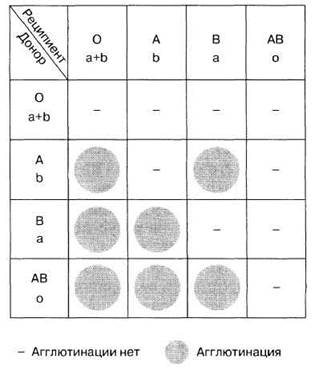
Fig. 14.43. Interactions determined by human blood groups. Cellular antigens are indicated by uppercase letters, and antibodies by lowercase letters.
Last update: 06/08/2026
Editorial and Educational Adaptation: This material has been compiled based on the primary/original source text. The project team performed an editorial review, corrected technical inaccuracies, structured sections, and adapted the content for an educational format.
What was processed:
- elimination of formatting defects (OCR errors, structural breaks, corrupted characters);
- editorial organization of content;
- standardization of terminology in accordance with academic sources;
- verification of factual statements against the original source text.
All mentions of the author, publication year, and origin of the primary text have been preserved in accordance with the source.