BIOLOGY Volume 1 - A Guide to General Biology - 2004
8. HETEROTROPHIC NUTRITION
8.3. The Human Alimentary Canal
8.3.5. Peristalsis
The food bolus is propelled along the alimentary tract As a result of Muscle contractions within the outer muscular coat of the gut wall. This coat consists of an outer longitudinal and an inner circular muscle layer (Fig. 8.12). Behind the food bolus, the circular Muscles contract, constricting the lumen of the gut, while ahead of the bolus, the longitudinal muscles contract, shortening and widening that section of the alimentary canal; as a result, the food is pushed forward (Fig. 8.18). This process is known as rhythmic segmentation.
In The Stomach and Small Intestine, another type of movement is possible: pendular movements, in which the walls of these Regions of the digestive tube abruptly and rapidly shorten, tossing the food from one wall to the other and thereby thoroughly mixing it. Strictly speaking, this type of movement is not considered peristaltic. The alimentary tract contracts simultaneously in several places (segmental movements).
Class="center">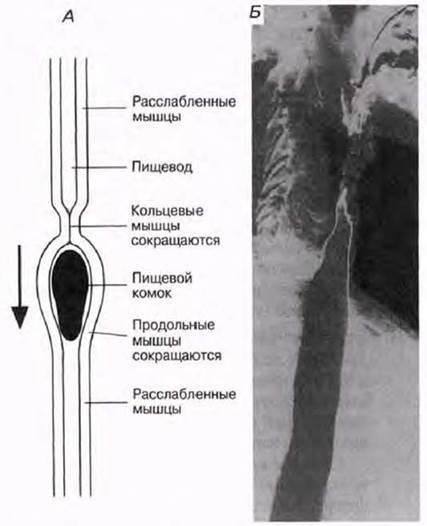
Fig. 8.18. A. Diagram of peristaltic movements in the Esophagus. B. X-ray of the human esophagus. The patient has previously swallowed a barium meal, which is opaque to X-rays. The Muscles of the esophageal section located above the barium meal contract and propel it toward the intestines.
Last update: 06/08/2026
Editorial and Educational Adaptation: This material has been compiled based on the primary/original source text. The project team performed an editorial review, corrected technical inaccuracies, structured sections, and adapted the content for an educational format.
What was processed:
- elimination of formatting defects (OCR errors, structural breaks, corrupted characters);
- editorial organization of content;
- standardization of terminology in accordance with academic sources;
- verification of factual statements against the original source text.
All mentions of the author, publication year, and origin of the primary text have been preserved in accordance with the source.