BIOLOGY Volume 1 - A Guide to General Biology - 2004
7. AUTOTROPHIC NUTRITION
7.8. Factors affecting photosynthesis
The rate of Photosynthesis is a critical factor influencing crop yields. Therefore, investigating the various environmental influences on photosynthesis is likely to lead to improved agricultural efficiency.
7.8. Based on the overall equation for photosynthesis, deduce which factors are likely to affect the rate of this process.
7.8.1. Limiting factors
Theoretically, the rate of any biochemical process that (like photosynthesis) involves a series of reactions will be limited by the slowest reaction in the sequence. For example, the METABOLISM/17.html">Light-Independent Reactions require reduced NADP and ATP, and are therefore dependent on the light-dependent reactions that produce these compounds. At low light intensities, the rate of their production is too low to sustain the maximum rate of the light-independent reactions; consequently, light acts as a limiting factor in this case. We can formulate the principle of limiting factors as follows:
when a chemical process is affected by more than one factor, its rate is limited by the factor whose value is closest to its minimum; changing this specific factor directly affects the rate of the process.
This principle was first stated by Blackman in 1905. Since then, it has been shown that other factors, such as carbon dioxide concentration and light intensity, interact and can act as simultaneous limiting factors, although one of them usually exerts a dominant effect. Analyze The impact of a single factor, such as light intensity, by examining Fig. 7.19, and try to answer the following questions:
Class="center">
Fig. 7.19. Effect of light intensity on the rate of photosynthesis.
7.9. a) What is the limiting factor in section A?
б) What is represented by sections B and C of this curve?
в) What does point D represent? d) What does point E represent?
Fig. 7.20 shows the results of four experiments in which the same Procedure was carried out at different temperatures and carbon dioxide concentrations.
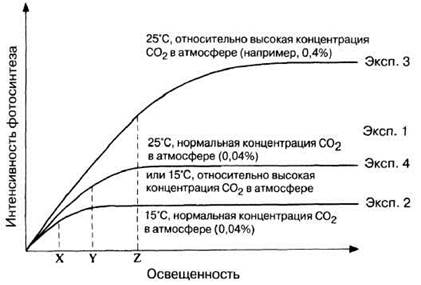
Fig. 7.20. Effect of various factors on the rate of photosynthesis.
7.10. What do points X, Y, and Z represent on the three curves in Fig. 7.20?
The experimental results (1–4 in Fig. 7.20) demonstrate that when light intensity ceases to be the limiting factor, Temperature and carbon dioxide concentration become limiting. Enzyme-controlled reactions, such as the light-independent reactions of photosynthesis, are sensitive to temperature changes; for instance, increasing the temperature from 15 to 25 °C leads to an increase in the rate of photosynthesis (compare experiments 2 and 1, or 4 and 3) provided that light is not a limiting factor. Carbon dioxide concentration can also act as a limiting factor for the light-independent reactions (compare experiments 2 and 4, or 1 and 3). For example, in experiment 2, both temperature and carbon dioxide concentration are limiting factors, so an increase in either of them will lead to an increased rate of photosynthesis.
Last update: 06/08/2026
Editorial and Educational Adaptation: This material has been compiled based on the primary/original source text. The project team performed an editorial review, corrected technical inaccuracies, structured sections, and adapted the content for an educational format.
What was processed:
- elimination of formatting defects (OCR errors, structural breaks, corrupted characters);
- editorial organization of content;
- standardization of terminology in accordance with academic sources;
- verification of factual statements against the original source text.
All mentions of the author, publication year, and origin of the primary text have been preserved in accordance with the source.