BIOLOGY Volume 1 - A Guide to General Biology - 2004
6. HISTOLOGY
6.6. Nervous Tissue
6.6.2. Nerves
Nerves consist of bundles of nerve fibers surrounded by a Connective Tissue sheath called the epineurium. Inward extensions of the epineurium, known as the perineurium, divide the bundle of nerve fibers into smaller fascicles, while each individual fiber is covered by its own connective tissue sheath known as the endoneurium (Fig. 6.31). Nerves are classified into two types based on the direction in which they transmit impulses. Sensory or afferent nerves, such as the olfactory, optic, and vestibulocochlear nerves, transmit impulses to the Central Nervous system, whereas efferent or motor nerves, such as the oculomotor, abducens, or trochlear nerves, transmit them away from the central nervous system. Mixed nerves transmit impulses in both directions (for example, all Spinal Nerves).
The conduction of nerve impulses is discussed in Chapter 17.
Class="center">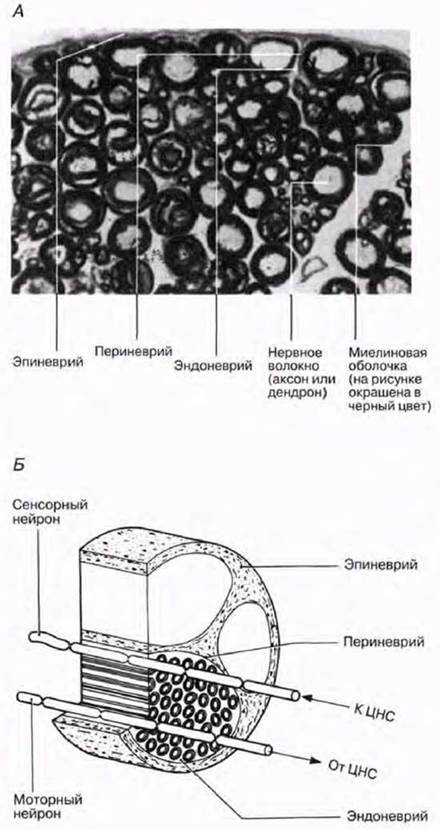
Fig. 6.31. Diagrammatic representations of a myelinated nerve fiber in cross-section (A) and a segment of such a fiber (B).
Last update: 06/08/2026
Editorial and Educational Adaptation: This material has been compiled based on the primary/original source text. The project team performed an editorial review, corrected technical inaccuracies, structured sections, and adapted the content for an educational format.
What was processed:
- elimination of formatting defects (OCR errors, structural breaks, corrupted characters);
- editorial organization of content;
- standardization of terminology in accordance with academic sources;
- verification of factual statements against the original source text.
All mentions of the author, publication year, and origin of the primary text have been preserved in accordance with the source.