Protein Structure and Function: Application of Bioinformatics Methods - John Rigden 2014
Protein Dynamics: From Structure to Function
Molecular Dynamics Calculations
Principles and Approximations
Despite significant algorithmic advancements, the fundamental theory underpinning MD simulations is quite straightforward. For biomolecular systems comprising N particles, the numerical solution of the time-dependent Schrödinger equation
Class="center">Structure/structure.files/image044.jpg" width="127"/>
for the N-particle wave function ψ(r,t) of the system is practically impossible. Therefore, certain approximations are necessary to enable the simulation of a solvated biomolecule on nanosecond time scales.
The first approximation concerns the arrangement of nuclei and electrons: due to their much smaller mass—and consequently much higher velocity—compared to nuclei, electrons can often be considered to adjust instantaneously to nuclear motion. Thus, within the Born-Oppenheimer approximation, one only needs to consider nuclear motion, with the Influence of the electronic degrees of freedom being described by the potential energy surface V(r). The second essential approximation used in MD relies on the classical description of nuclear motion via Newton's laws

where mi and rі denote the mass and position of the i-th Nucleus, respectively. To obtain the potential energy V(r), the Schrödinger equation must be solved for the electronic degrees of freedom while treating the nuclear motion classically. However, given the large number of participating electrons, a further simplification is required: the Introduction of semi-empirical force fields that approximate V(r) using A large number of functionally simple energy terms for bonded and non-bonded interactions. In general form,
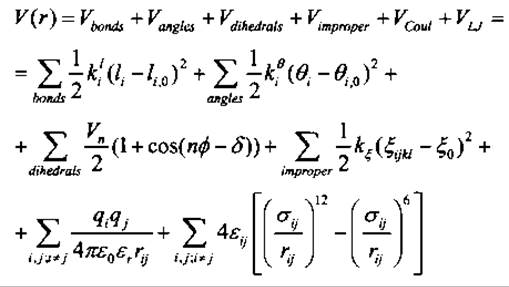
These simple terms often take a harmonic form (e.g., Vbonds, Vangles, Vimproper) or arise from physical laws (such as Coulomb's law VCoul and the Lennard-Jones potential VLJ). These terms are defined by their functional form and a small set of parameters, such as the atomic radius in the case of Van der Waals interactions. All parameters are derived either from ab initio quantum chemical calculations or by comparing structural and thermodynamic data with appropriate averages for Molecular Dynamics ensembles of small molecules. The number of energy terms, their functional form, and individual parameters can vary significantly among different force fields (Brooks et al. 1983; Weiner et al. 1986; Van Gunsteren and Berendsen 1987; Jorgensen et al. 1996).
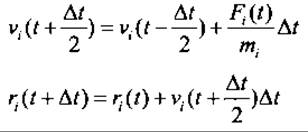
Based on the aforementioned description of a protein as a system of point masses (with coordinates rj and velocities vi) moving in a classical potential field under the action of external forces Fi, a standard MD calculation with a discrete time step At in the femtosecond range integrates Newton's equations of motion using a specific numerical scheme, such as the leap-frog algorithm (Hockney et al. 1973):
Despite interactions with membranes and other macromolecules, Water serves as the primary environment for Proteins. To model a system that closely mimics an in vivo environment, the protein must be solvated by adding water molecules and ions at a physiological concentration. In a simulation box filled with a protein and solvent, boundary-related artifacts such as evaporation, high pressure due to surface tension, and solvent molecule orientation at the surface may arise. To avoid these artifacts, periodic boundary conditions are frequently employed. In this approach, surfaces vanish entirely from the model system; however, this can introduce new artifacts if a molecule artificially interacts with its periodic image due to, for instance, long-range Electrostatic Interactions. These periodicity-induced artifacts can be minimized by enlarging the simulation box. Various box geometries, such as a cube, dodecahedron, or truncated octahedron, allow for the optimal fitting of the box to a specific protein shape, thereby striking a compromise between the number of solvent molecules and the distance between the protein molecule and its periodic image.
Because the solvent environment profoundly affects Cell/13.html">Protein Structure and dynamics, water parameters must be carefully chosen. Despite The Emergence of implicit solvent models—where water is represented as a continuum rather than individual "explicit" molecules (Still et al. 1990; Gosh et al. 1998; Jean-Charles et al. 1991; Luo et al. 2002)—various explicit models remain widely used today (e.g., Jorgensen et al. 1983). These models differ in the number of particles used to represent a water molecule and the placement of static partial charges, which account for polarity and, effectively, polarization in most force fields. Because these charges remain constant throughout the simulation, explicit polarization effects are omitted. Currently, several polarizable water models (and corresponding force fields) are available (see the recent review by Warshel et al. (2007)).
When solving Newton's equations of motion, the total energy of the system is conserved, yielding a microcanonical NVE ensemble characterized by a constant number of particles N, volume V, and energy E. Real biological systems of tractable simulation size, however, constantly exchange energy with their surroundings. Moreover, they experience a constant pressure P, typically equal to atmospheric pressure (1 bar). To account for these features, algorithms have been developed to maintain constant Temperature and pressure (Andersen 1980; Nosé 1984; Berendsen et al. 1984), leading to the canonical NPT ensemble.
Last update: 06/08/2026
Editorial and Educational Adaptation: This material has been compiled based on the primary/original source text. The project team performed an editorial review, corrected technical inaccuracies, structured sections, and adapted the content for an educational format.
What was processed:
- elimination of formatting defects (OCR errors, structural breaks, corrupted characters);
- editorial organization of content;
- standardization of terminology in accordance with academic sources;
- verification of factual statements against the original source text.
All mentions of the author, publication year, and origin of the primary text have been preserved in accordance with the source.