Protein Structure and Function. Application of Bioinformatics Methods - John Rigden 2014
Prediction of protein function based on surface properties
Protein-protein interface
Prediction of interface location
As already mentioned, non-obligate protein interfaces lack a unique definition, which is why relying on a single property to locate a protein interface is usually unsuccessful. Combining multiple properties—none of which independently points to the Active Site—can predict protein interfaces with high accuracy. Some Methods base their predictions on selecting the surface patch most resembling an interface among circular patches covering the entire protein surface. For each such patch, a set of features is calculated and compared with typical characteristics observed in known interfaces.
The simplest algorithm, implemented in the Sharp2 program (Murakami and Jones 2006), uses a single formula combining six properties (Jones and Thornton 1997). These properties are: (1) Structure/106.html">Hydrophobicity, measured using experimentally derived values; (2) solvation, measured using analogous values; (3) the propensity of each residue to be located at the interface; (4) patch flatness; (5) patch roughness; and (6) the fractional area of a patch. This algorithm has proven successful for approximately 65% of tested complexes. Prediction quality can be improved by employing various machine learning methods (Procedures capable of revealing correlations among properties). The PPI-Pred program (Bradford and Westhead 2005) implements a very similar approach, applying machine learning to the same properties described for Sharp2 (Fig. 7.7). Other methods utilize alternative residue parameters—for instance, hydrophobicity, atomic solvation energy, residue surface accessibility, and sequence conservation have all been successfully applied (Bordner and Abagyan 2005).
Class="center">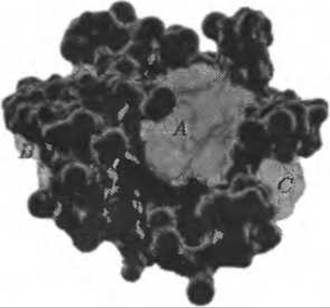
Fig. 7.7. Interface prediction using the PPI-Pred program. Predicted active sites On the surface offerredoxin reductase are shown (PDB code 1EWY, chain A). Label A indicates the active site ranked at the top of the list of patches, which corresponds closely to the true Active Site of ferredoxin; B and C denote the second- and third-ranked patches, respectively, covering other Regions of the protein surface.
Table 7.1. Internet resources and web services related to function Prediction Based on protein surface analysis.
Method |
URL |
|
Function prediction based on protein surface analysis |
|
ef-Site |
http://ef-site.hgc.jp |
PatchFinderPlus |
http://pfp.technion.ac.il/ |
Scorcons |
http://www.ebi.ac.uk/thornton-srv/Databases/cgi-bin/valdar/scoreconsserver.pl |
ConSurf |
http://consurf.tau.ac.il/ |
hotpatch |
http://hotpatch.mbi.ucla.edu |
|
Ligand-binding site prediction |
|
PASS |
http://www.ccl.net/cca/software/UNIX/pass/Overview.shtml |
CASTp |
http://sts-fw.bioengr.uic.edu/castp/ |
SurfNet |
http://www.biochem.ucl.ac.uk/~roman/surfhet/surfhet.html |
PDBsum |
http://www.ebi.ac.uk/pdbsum/ |
Pocket-Finder |
http://www.bioinformatics.leeds.ac.uk/pocketfinder |
LIGSITEcsc |
http://scoppi.biotec.tu-dresden.de/pocket/ |
PocketPicker |
http://gecco.org.chemie.uni-frankfurt.de/pocketpicker/index.html |
Q-SiteFinder |
http://www.bioinformatics.leeds.ac.uk/qsitefmder |
THEMATICS |
http://pfweb.chem.neu.edu/thematics/submit.html |
|
Protein-protein interaction interface prediction |
|
Sharp2 |
http://www.bioinformatics.sussex.ac.uk/SHARP2/sharp2.html |
PPI-PRED |
http://www.bioinformatics.leeds.ac.uk/ppi_pred/ |
InterProSurf |
http://curie.utmb.edu/ |
Cons-PPISP |
http://pipe.scs.fsu.edu/ppisp.html |
ProMate |
http://bioportal.weizmann.ac.il/promate/ |
Another method, implemented in the ProMate program (Neuvirth et al. 2004), achieves comparable success by utilizing hydrophobicity, atomic distribution, chemical group preferences, neighboring residue propensities, residue conservation, Secondary structure type, sequential residue Separation, loop length, and crystallographic Water localization. Several other Similar Methods are also listed in Table 7.1. Furthermore, a performance comparison of these methods has been conducted (Zhou and Qin 2007).
Last update: 06/08/2026
Editorial and Educational Adaptation: This material has been compiled based on the primary/original source text. The project team performed an editorial review, corrected technical inaccuracies, structured sections, and adapted the content for an educational format.
What was processed:
- elimination of formatting defects (OCR errors, structural breaks, corrupted characters);
- editorial organization of content;
- standardization of terminology in accordance with academic sources;
- verification of factual statements against the original source text.
All mentions of the author, publication year, and origin of the primary text have been preserved in accordance with the source.