Principles of Protein Structure - G. Schultz 1982
Interactions Determining Protein Structure
Dispersion Forces and Electron Shell Repulsion
Dispersion attractive forces act between any pairs of atoms. Dispersion forces exist between any pair of atoms, even if they are completely nonpolar. If an atom is represented as an oscillating dipole, in a pair of atoms each dipole will polarize the neighboring atom. As a result, an attractive force arises between the atoms, the energy of which, in the first approximation, is inversely proportional to the sixth power of the distance between the atomic nuclei [45] and proportional to the polarizabilities of the atoms [46].
The polarizability of an atom incorporated into a molecule is anisotropic; therefore, dispersion forces depend on the relative orientation of molecular fragments. However, because The Effect of orientation is small and difficult to measure, it is usually neglected and dispersion forces are considered isotropic.
The electron shells of non-bonded atoms repel each other mutually. The dispersion attraction forces between a pair of non-bonded atoms are counterbalanced by the repulsion of their electron shells. This repulsion was approximated by Lennard-Jones by introducing a term inversely proportional to the m-th power of the distance [47]. Slater [48] described the repulsion using an exponential function, which was later modified by Buckingham [49] and bears his name. In protein calculations, the Lennard-Jones approximation with m = 12 is most frequently used. Taking into account the London term for dispersion forces [45], this leads to the computationally simple 6–12 potential, an example of which is shown in Fig. 3.1. Both parameters required to define this function are described in the figure legend. The potential in Fig. 3.1 has a minimum in the negative region at a distance of Rm. Therefore, the atoms are weakly "bound" at this distance (Em being the attractive energy).
Energy parameters can be determined from crystal Structure data. The absolute magnitude of the 6–12 Lennard-Jones potential parameters can be determined from Contact distances and contact energies in crystals of small molecules, which are derived from X-Ray Diffraction dataa and, for example, heats of sublimation. These same data can also be obtained from atomic and molecular beam scattering experiments.
Class="center">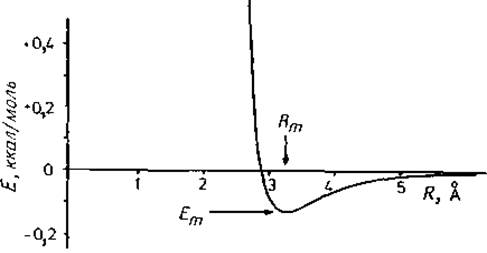
Fig. 3.1. The 6–12 Lennard-Jones potential describing dispersion forces and electron repulsion (Rm = 3.24 Å, Em = —0.13 kcal/mol).
The two-parameter formula is given below in a computationally convenient form (where A and B are parameters), as well as in its normalized form (where Em and Rm are parameters); the quantities A and B are positive. With a decrease in B and an increase in A, Em decreases, while the corresponding interatomic distance Rm increases. The potential barrier is asymmetric. Repulsion and attraction balance each other at a distance of 0.89∙Rm; at a distance of 1.5∙Rm, the attraction energy is only one-sixth of Em.

Examples of such parameters are given in Table 3.2. The differences between the data characterize the magnitude of potential errors.
As can be seen from Table 3.2, the fraction of energy contributed by an atomic contact is very small. However, the number of contacts in a protein is large. For example, in a closest hexagonal packing of identical spheres, each sphere forms contacts with 12 neighbors. Since contact energies are additive, the total attractive energy per sphere in this case is six times greater than the energy contributed by a single contact.
Table 3.2 Parameters of the 6–12 Lennard-Jones potential for electron shell repulsion and dispersion forces in non-bonded contacts a
|
Interaction |
Momany et al. data [69] |
Lifson and Warshel data [70, 71] |
||
|
Em, kcal/mol |
kcal/mol |
Rm, Å |
||
|
Aliphatic H ... aliphatic H Aliphatic C ... aliphatic C Carbonyl O ... carbonyl ... O Amide N ... amide N |
—0.04 —0.04 —0.20 —0.11 |
2.92 4.12 3.12 3.51 |
—0.01 —0.19 —0.23 —0.19 |
2.94 4.23 3.00 3.60 |
a Only contacts between identical atom types are listed. For a contact between non-identical types i and j, we obtain 

Last update: 06/08/2026
Editorial and Educational Adaptation: This material has been compiled based on the primary/original source text. The project team performed an editorial review, corrected technical inaccuracies, structured sections, and adapted the content for an educational format.
What was processed:
- elimination of formatting defects (OCR errors, structural breaks, corrupted characters);
- editorial organization of content;
- standardization of terminology in accordance with academic sources;
- verification of factual statements against the original source text.
All mentions of the author, publication year, and origin of the primary text have been preserved in accordance with the source.