Principles of Protein Structural Organization - H. Schultz 1982
Interactions Determining Protein Structure
Non-covalent interactions were discovered by Structure/103.html">Van der Waals (1873) in his attempt to explain the deviation of real gas behavior from the ideal gas law. Interactions between non-bonded atoms are of paramount importance for biological organisms; specifically, they are responsible for the spontaneous folding of polypeptide and nucleic acid chains, as well as the spontaneous formation of membranes. They drive the recognition of complementary molecular surfaces (the "lock-and-key" mechanism) [44].
The various types of non-covalent interactions are listed in Table 3.1; their absolute bond energy is one to three orders of magnitude smaller than that of covalent bonds. The magnitude of non-covalent interactions is both difficult to measure and difficult to calculate. Furthermore, the surrounding environment makes a significant entropic contribution to Protein Stabilization. Therefore, the system must be considered as a whole, taking into account both the protein and the solvent.
Class="center">Table 3.1 Types of interactions important for protein structuresa
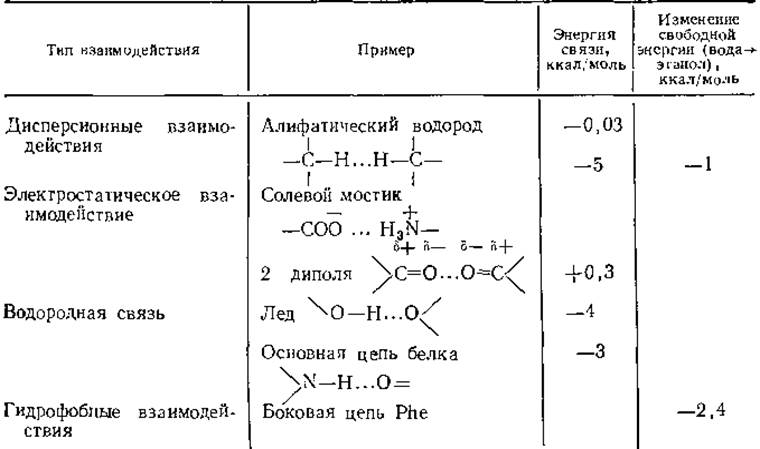
a In calculations of electrostatic interaction energy, the dielectric constant is assumed to be 4.
Last update: 06/08/2026
Editorial and Educational Adaptation: This material has been compiled based on the primary/original source text. The project team performed an editorial review, corrected technical inaccuracies, structured sections, and adapted the content for an educational format.
What was processed:
- elimination of formatting defects (OCR errors, structural breaks, corrupted characters);
- editorial organization of content;
- standardization of terminology in accordance with academic sources;
- verification of factual statements against the original source text.
All mentions of the author, publication year, and origin of the primary text have been preserved in accordance with the source.