Biochemistry - The Chemical Reactions of Living Cells, Volume 3 - D. Metzler 1980
Biochemical Genetics and the Synthesis of Nucleic Acids and Proteins
Transcription of RNA Molecules
Ribosomal RNA (rRNA)
Quantitatively, the most crucial role belongs to ribosomal RNA, which accounts for up to 90% of all cellular RNA. rRNA synthesis must proceed rapidly, since a single E. coli Cell produces 5–10 new Ribosomes per second, or 2∙104 RNA molecules per generation. Each ribosome contains three RNA molecules. The sedimentation constants, molecular weights, and nucleotide counts for RNA from several Bacteria are listed below.
Class="center">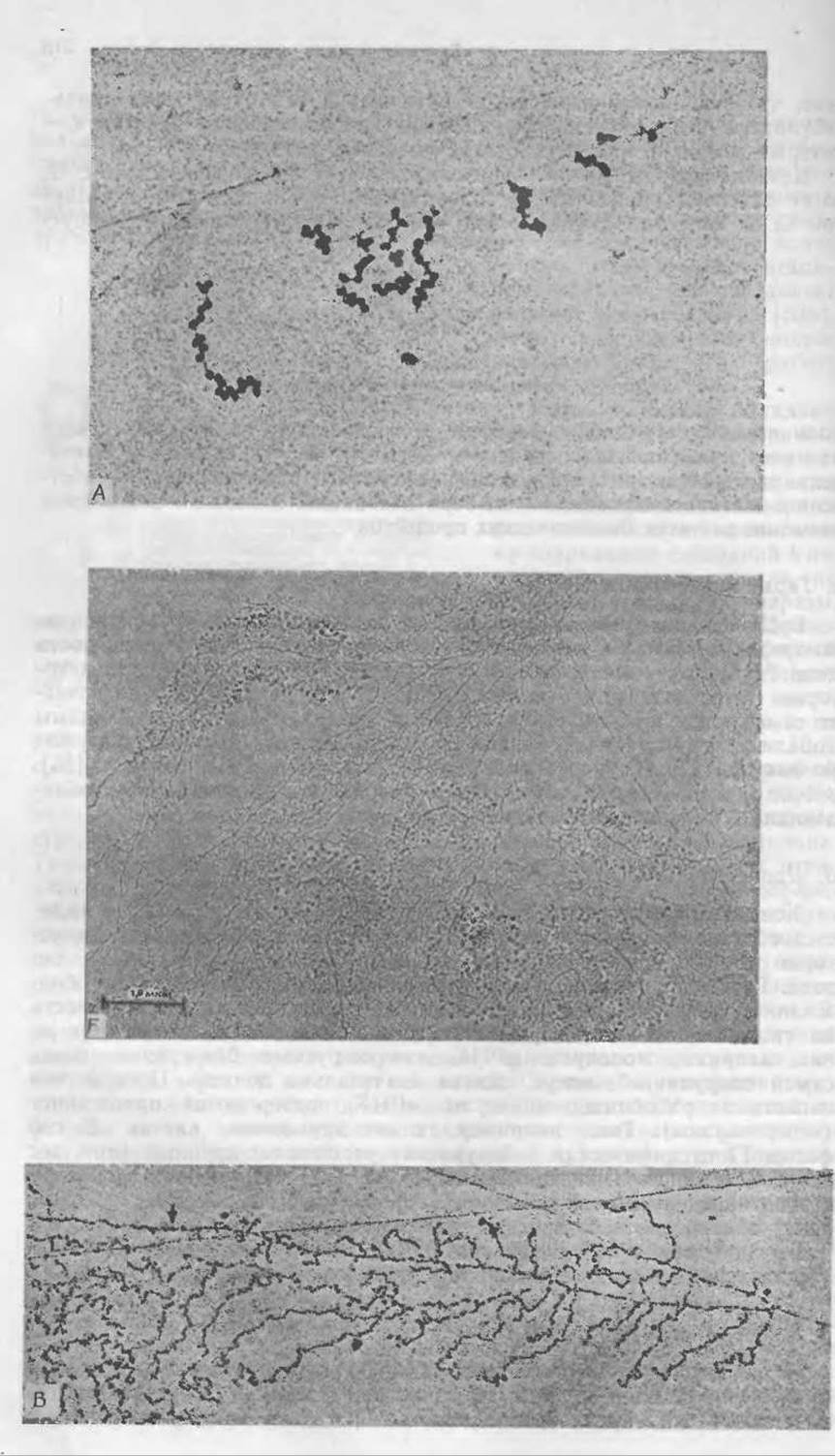
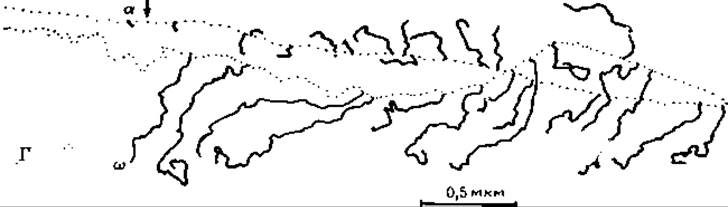
FIG. 15-7. A. Electron micrograph showing METABOLISM/31.html">Transcription of an unidentified E. coli Operon. The double-stranded DNA molecule (horizontal) and mRNA chains with attached ribosomes are visible. On the right, where transcription has just begun, the RNA chains are shorter, whereas further to the left, where transcription has proceeded for some time, they are longer (from Miller et al., Science, 169, 392–395). B. Transcription of ribosomal RNA genes in an embryo of Drosophila melanogaster (fruit fly). At the top left, a fully activated transcription unit is visible. Shorter matrices visible at the bottom are not yet fully formed. Note the densely packed ribonucleoprotein fibrils containing growing transcribed rRNAs and the characteristic granules at the ends of the fibrils (from [59c]). C. Electron micrograph of a nonribosomal transcription unit from an embryo of Oncopeltus fasciatus. D. Interpretive drawing of the micrograph in C. Dashed lines represent Chromatin, and solid lines represent ribonucleoprotein fibrils. Careful measurements revealed that the increase in length of these 29 fibrils from the shortest (designated a) to the longest (designated co) is proportional to the distance along the chromatin fiber. The least-squares straight line graphically depicting the dependence of ribonucleoprotein fibril length on distance intersects the X-axis at the point indicated by the arrows in C and D. Transcription is believed to initiate near this point and extend approximately 6.0 µm to the termination point. The longest ribonucleoprotein fibril on the micrograph lies 5.8 µm from the origin. According to the obtained results, the DNA length in this region of partially folded chromatin is 9.6 µm, which corresponds to approximately 21,000 Base Pairs (drawing and micrograph from [59a]).
|
Sedimentation constant (S) |
Mol. wt. |
Number of NUCLEOTIDES |
|
23 |
1.1∙106 |
3300 |
|
16 |
0.56∙106 |
1700 |
|
5 |
4.1∙104 |
120 |
All three rRNA molecules exist in Cells as larger precursor molecules (pre-rRNA) containing excess nucleotide sequences at both the 3' and 5' ends. Two precursors of 5S RNA have been identified in E. coli, one containing 150 nucleotides and the other 180.
It is now generally accepted that there are approximately six rRNA-coding regions in the E. coli chromosome. Each of these regions constitutes a single transcription unit containing one Gene for each of the three RNA types (16S, 23S, and 5S). These genes are arranged in the same order as the corresponding RNAs are listed here. A single primary transcript (which in certain strains may have a sedimentation constant of 30S) is cleaved by an endonuclease (RNase III) into smaller pre-rRNA molecules [57, 58].
Strikingly precise confirmation of these data was obtained from electron microscopic examination of active chromosomal regions in growing E. coli cells: researchers were able to visualize nascent chains, evidently representing 16S and 23S rRNAs [59, 59a–c] (Fig. 15-7).
Last update: 06/08/2026
Editorial and Educational Adaptation: This material has been compiled based on the primary/original source text. The project team performed an editorial review, corrected technical inaccuracies, structured sections, and adapted the content for an educational format.
What was processed:
- elimination of formatting defects (OCR errors, structural breaks, corrupted characters);
- editorial organization of content;
- standardization of terminology in accordance with academic sources;
- verification of factual statements against the original source text.
All mentions of the author, publication year, and origin of the primary text have been preserved in accordance with the source.