Biochemistry - The Chemical Reactions of Living Cells Volume 2 - D. Metzler 1980
Enzymes: Protein Catalysts of Cells
Fundamentals of Enzyme Kinetics
First-Order Reactions
For many Chemical Reactions, The rate of decrease in the concentration of a given reactant, [A], is directly proportional to the concentration of this reactant:
Class="center">
The proportionality constant k is referred to as the rate constant. First-order kinetics is observed in unimolecular processes, where a molecule A converts into a product P, and the probability of this conversion within a given time interval does not depend on interactions with other molecules. A classic example of such a process is radioactive decay. In many cases, the transformations of enzyme-substrate complexes function as unimolecular processes. Frequently, first-order reactions are pseudo-unimolecular: substance A reacts with a second molecule (such as a Water molecule), but this second substance is present in large excess, meaning its concentration remains essentially constant throughout the experiment, and thus the reaction rate depends solely on [A].
The first-order rate constant k has dimensions of s-1. Note that when [A] = 1, v = k. Thus, the first-order rate constant is numerically equal to the reaction rate (in M∙s-1) at a unit concentration of the substance. During a first-order reaction, the value of [A] decreases over time and, at a given time t, is expressed by one of three equivalent equations obtained by integrating equation (6-2):
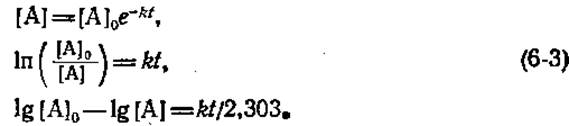
Equations (6-3) represent exponential decay equations—a process characterized by the independence of the half-life, t1/2 (i.e., the time required for the concentration of substance A to decrease by half), from the Reactant Concentration:

The relaxation time τ for substance A is defined by the expression

and represents the time required for the concentration to decrease to 1/e (~0.37) of its initial value.
Last update: 06/08/2026
Editorial and Educational Adaptation: This material has been compiled based on the primary/original source text. The project team performed an editorial review, corrected technical inaccuracies, structured sections, and adapted the content for an educational format.
What was processed:
- elimination of formatting defects (OCR errors, structural breaks, corrupted characters);
- editorial organization of content;
- standardization of terminology in accordance with academic sources;
- verification of factual statements against the original source text.
All mentions of the author, publication year, and origin of the primary text have been preserved in accordance with the source.