Biochemistry - The Chemical Reactions of Living Cells Volume 2 - D. Metzler 1980
Biosynthesis: How New Molecules Are Formed
Biosynthesis of Monomers
Stabilization and Termination of Chain Growth via Cyclization
Another synthesis principle is based On the Stability of five- and six-membered rings. Biologically active compounds often undergo cyclization to form cyclic structures. For example, whereas three-carbon glyceraldehyde phosphate exists in solution predominantly as the free aldehyde [in equilibrium with the covalent hydrate; equation (7–35)], glucose-6-phosphate exists mainly as a cyclic hemiacetal:
Class="center">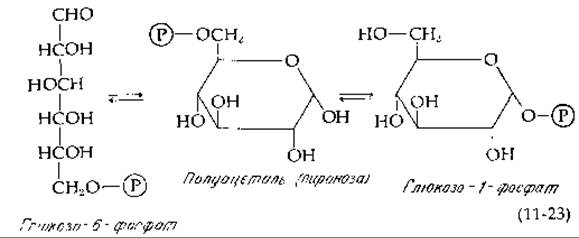
This cyclic form contains no carbonyl groups; consequently, its formation puts an end to any further chain elongation1). During the enzymatic isomerization of the hemiacetal to glucose-1-phosphate [equation (11-23), or via glucose-1-diphosphate, equation (7-26)], ring closure takes place first. Glucose-1-phosphate, in turn, serves as a biosynthetic precursor for Polysaccharides and related compounds featuring stable sugar rings. Ring formation can also occur in Lipid Biosynthesis. Among Polyketides (Chap. 12, Sec. G), there are numerous compounds in which ring formation results from ester or aldol Condensation followed by reduction and elimination processes. This sequence is typical for The biosynthesis of highly stable aromatic rings.
1) Sometimes, however, six-carbon chains can undergo elongation, as is the case, for instance, in The formation of N-acetylneuraminic acid [equation (12-6)]
Last update: 06/08/2026
Editorial and Educational Adaptation: This material has been compiled based on the primary/original source text. The project team performed an editorial review, corrected technical inaccuracies, structured sections, and adapted the content for an educational format.
What was processed:
- elimination of formatting defects (OCR errors, structural breaks, corrupted characters);
- editorial organization of content;
- standardization of terminology in accordance with academic sources;
- verification of factual statements against the original source text.
All mentions of the author, publication year, and origin of the primary text have been preserved in accordance with the source.