Human Biochemistry, Volume 2 - Murray R. 1993
Structure, Function, and Replication of Information Macromolecules
Nucleotides
Structure of Purine and Pyrimidine Bases
Purine and pyrimidine bases, which are components of NUCLEOTIDES, are substituted derivatives of purine and pyrimidine (Fig. 34.1). The positions of atoms in the aromatic ring are numbered according to accepted nomenclature. Note that the numbering in the purine and pyrimidine rings proceeds in opposite directions, whereas carbon atom number 5 occupies the same relative position in both molecules. The conjugation of $\pi$-electron clouds determines the planar Structure of purine and pyrimidine bases. The Significance of this phenomenon is discussed in Chapter 37.
Major Bases
The major pyrimidine bases in both PROKARYOTES AND EUKARYOTES are cytosine, thymine, and uracil (Fig. 34.2). Among purine bases, adenine and guanine are the most common. Two others, xanthine and hypoxanthine, serve as intermediates in their metabolic pathways (Fig. 34.3). In humans, the end product of purine Catabolism is uric acid, an oxidized purine base (Chapter 35).
Class="center">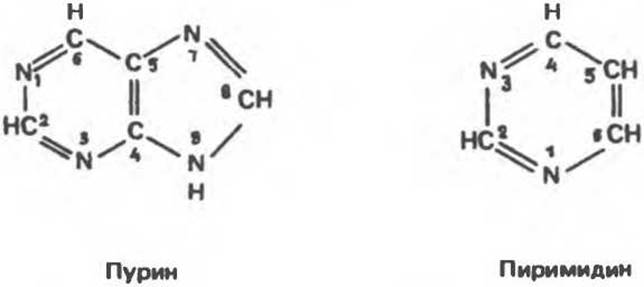
Fig. 34.1. Structure of purine and pyrimidine. Atoms are numbered According to the international system.

Fig. 34.2. Three major pyrimidine bases found in nucleotides.
In addition to the five major bases mentioned above, less widely distributed minor bases are also known. Some of these occur exclusively in bacterial and viral Nucleic Acids, while many others are found in both pro- and eukaryotic DNAs and Transfer RNAs. For instance, both bacterial and human DNAs contain significant amounts of 5-methylcytosine; 5-hydroxymethylcytosine has been identified in Bacteriophages (Fig. 34.4). Unusual bases have been detected in Messenger RNA, including N6-methyladenine, N6, N6-dimethyladenine, and N7-methylguanine (Fig. 34.5). Bacteria also contain a modified uracil with an (α-amino, α-carboxy)propyl group attached at the N3 position. The Functions of these substituted Purines and Pyrimidines are not yet fully understood.

Fig. 34.3. Major purine bases found in nucleotides.

Fig. 34.4. Structure of two unusual naturally occurring pyrimidine bases.
A series of methylated purine bases has been identified in plant Cells (Fig. 34.6). Many of these compounds are pharmacologically active. Examples include coffee beans, which contain caffeine (1, 3, 7-trimethylxanthine); tea leaves, containing theophylline (1, 3-dimethylxanthine); and cocoa beans, which contain theobromine (3, 7-dimethylxanthine). The biological properties of these substances are described in Chapter 35 in the Discussion of cyclic Nucleotide METABOLISM.
Last update: 06/08/2026
Editorial and Educational Adaptation: This material has been compiled based on the primary/original source text. The project team performed an editorial review, corrected technical inaccuracies, structured sections, and adapted the content for an educational format.
What was processed:
- elimination of formatting defects (OCR errors, structural breaks, corrupted characters);
- editorial organization of content;
- standardization of terminology in accordance with academic sources;
- verification of factual statements against the original source text.
All mentions of the author, publication year, and origin of the primary text have been preserved in accordance with the source.