Principles of Biochemistry Volume 3 - A. Lehninger 1985
Molecular Mechanisms of Genetic Information Transmission
DNA: Structure of Chromosomes and Genes
DNA-histone complexes form bead-like nucleosomes
Chromatin fibers resemble beads on a string in appearance (Fig. 27-23). The repeating, bead-like structures of these fibers are called nucleosomes. A nucleosome is a complex consisting of a double-stranded DNA molecule about two hundred Base Pairs long and a set of histone molecules around which the DNA is wrapped twice; the nucleosomes ("beads") have a diameter of 10–11 nm. Each nucleosome contains eight histone molecules—two molecules each of Histones H2A, H2B, H3, and H4. The DNA strand is wound around the outside of the histone core of the nucleosome.
Class="center">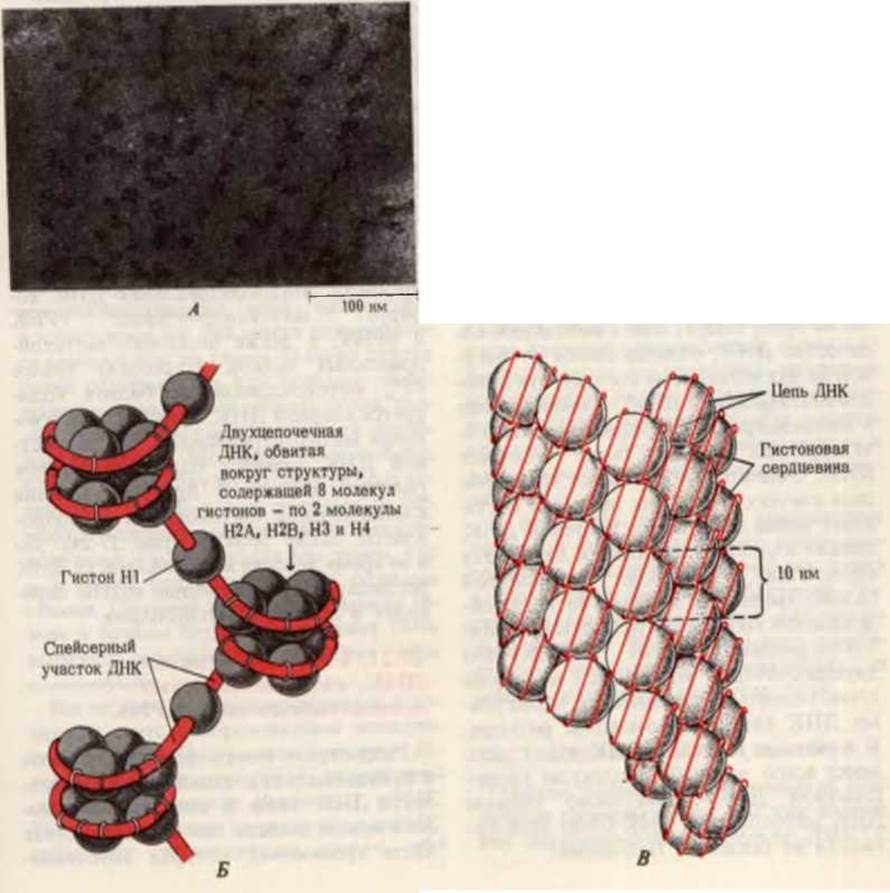
Fig. 27-23. Nucleosomes. A. Electron micrograph of extended chromatin fibers, showing bead-like nucleosomes. B. Schematic diagram of an extended region of a chromatin fiber illustrating The Structure of nucleosomes. C. Schematic diagram of the compact structure formed by nucleosomes and spacer DNA regions.
Located between adjacent nucleosomes is linker (spacer) DNA, which is bound by histone H1. The length of these connecting DNA regions varies from 20 to 120 base pairs depending on the species and Cell type. In human chromatin fibers, this length is about 50 base pairs. Nucleosomes are the structural units of chromatin, serving primarily to package DNA densely. In addition to the shortening of double-stranded DNA caused by wrapping around histones, further compaction and tight packaging of eukaryotic DNA in chromatin are achieved through the ordered spatial arrangement of nucleosomes (Fig. 27-23). Chromatin is also associated with non-histone Nuclear Proteins that form the nuclear matrix.
Last update: 06/08/2026
Editorial and Educational Adaptation: This material has been compiled based on the primary/original source text. The project team performed an editorial review, corrected technical inaccuracies, structured sections, and adapted the content for an educational format.
What was processed:
- elimination of formatting defects (OCR errors, structural breaks, corrupted characters);
- editorial organization of content;
- standardization of terminology in accordance with academic sources;
- verification of factual statements against the original source text.
All mentions of the author, publication year, and origin of the primary text have been preserved in accordance with the source.