Principles of Biochemistry Volume 3 - A. Lehninger 1985
Molecular Mechanisms of Genetic Information Transfer
DNA: Structure of Chromosomes and Genes
Viral DNA molecules are relatively small in size
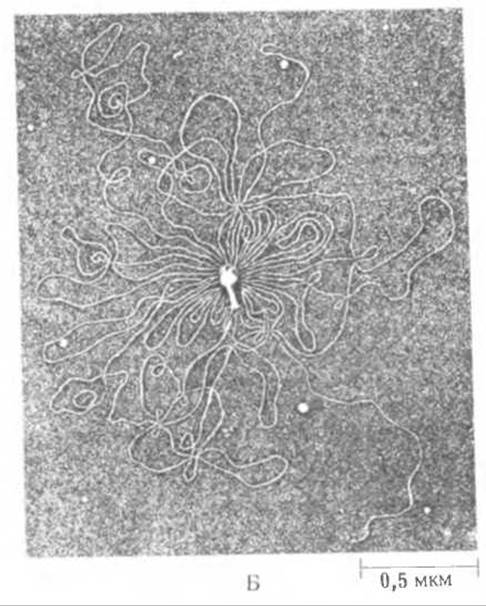
Table 27-4 shows the weights of several DNA-containing Viral Particles, their approximate sizes, the molecular weights of their DNA, and the number of Base Pairs contained in their molecules. Knowing the Molecular Weight of a double-stranded viral DNA, one can determine its physical length, since the molecular weight of each nucleotide pair averages approximately 650, and, as we have already seen, there is one nucleotide pair for every 0.34 nm of the duplex. A typical example of a small DNA-containing virus is bacteriophage λ. The intracellular, or replicative, form of its DNA is a double helix in which the 5'- and 3'-ends of each strand are covalently joined, forming a ring (not in the sense of a geometric circle, but in the sense of a closed loop with no ends). The double-stranded DNA of this virus has a molecular weight of ~32∙106, meaning it consists of approximately 48,000 base pairs; its physical length is ~17.2 µm (Fig. 27-17). The DNA of many other Introduction/6.html">DNA-containing Viruses also exists as circular duplexes. Some viruses, such as bacteriophage T2, contain linear double-stranded DNA—that is, a molecule with two ends—whereas others, such as bacteriophage φX174, contain a single-stranded circular DNA molecule. During the Replication cycle, linear DNA molecules often convert to a circular form, and all single-stranded viral DNA molecules become double-stranded. These specialized forms of DNA that appear only during viral replication are called replicative forms.
Class="center">Table 27-4. DNA of some bacterial viruses
Virus |
Viral particle weight, 106 daltons |
Particle length, nm |
Molecular weight, 106 |
Approximate number of base pairs |
φX174 (replicative form) |
6 |
15 |
3.4 |
5,3861) |
T7 |
38 |
6 |
25 |
40,000 |
λ |
50 |
20 |
32 |
48,000 |
T2, T4 |
220 |
18 |
120 |
182,000 |
1) Since the complete nucleotide sequence of phage φX174 DNA is known, the given figure corresponds to the exact number of base pairs.
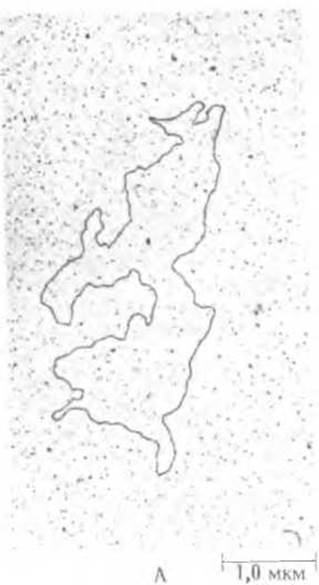
Fig. 27-17. Cytology/cytology/93.html">ELECTRON MICROGRAPHS OF DNA from two Bacteriophages. A. DNA of bacteriophage λ. The molecular weight of this DNA is ~32∙106, and its molecular length is 17.2 µm. B. Electron micrograph of bacteriophage T2 surrounded by its own linear DNA molecule. The DNA has been released from the viral particle and spread across the surface As a result of the lysis of the bacteriophage in distilled Water.
Another important feature of viral DNAs is that their physical length vastly exceeds the dimensions of the viral particles that enclose them, as clearly seen in the case of phage T2 (Fig. 27-17, Table 27-4). Obviously, viral DNA must be packaged extremely compactly to fit inside the viral particle.
In RNA-containing Viruses, RNA serves as the chromosome. Viral RNAs are generally relatively small; they contain a small number of genes and typically consist of a single strand. The overwhelming majority of plant viruses contain RNA.
Last update: 06/08/2026
Editorial and Educational Adaptation: This material has been compiled based on the primary/original source text. The project team performed an editorial review, corrected technical inaccuracies, structured sections, and adapted the content for an educational format.
What was processed:
- elimination of formatting defects (OCR errors, structural breaks, corrupted characters);
- editorial organization of content;
- standardization of terminology in accordance with academic sources;
- verification of factual statements against the original source text.
All mentions of the author, publication year, and origin of the primary text have been preserved in accordance with the source.