Principles of Biochemistry, Volume 3 - A. Lehninger 1985
Molecular Mechanisms of Genetic Information Transfer
DNA: Structure of Chromosomes and Genes
Certain physical properties of double-stranded DNA reflect the ratio of G=C to A=T base pairs in its composition
When solutions of viral or bacterial DNA are heated slowly, their molecules undergo Denaturation at well-defined temperatures (Fig. 27-16). This transition from the native DNA duplex to an unwound, randomly coiled denatured form can be detected by an increase in ultraviolet Light absorption or a decrease in the viscosity of the DNA solution. Each species of DNA has a characteristic denaturation Temperature, known as the “melting point.” The higher the proportion of G≡C pairs in a DNA molecule, the higher its melting point. This occurs because G≡C pairs are more stable and require more energy to dissociate than A=T pairs; this stability is partly due to the three Hydrogen Bonds holding G≡C pairs together, compared with only two for A=T pairs. Consequently, a precise Determination of the melting point of a DNA sample under fixed pH and Ionic strength conditions can provide valuable information about The ratio of A=T to G≡C pairs in the DNA.
A second physical property of DNA governed by the ratio of G≡C to A=T pairs is buoyant density. DNA preparations with a higher G≡C content have a slightly greater density than those enriched in A=T pairs. DNA samples are centrifuged at high speeds in a concentrated cesium chloride (CsCl) solution, whose density spans the same range as that of DNA. During centrifugation, a CsCl density gradient forms in the centrifuge tube, with the highest density at the bottom of the tube. When DNA is added to the solution, it initially migrates toward the bottom of the tube, but eventually stops at a specific position and floats. At this equilibrium position, it neither sediments nor floats further because the density of the surrounding CsCl solution matches its own buoyant density. As discussed in greater detail in Chapter 28, this method makes it possible to separate DNA molecules that differ in G≡C content, as they possess different buoyant densities. The ratio of G≡C to A=T pairs can be calculated directly from the buoyant density of a given DNA.
Class="center">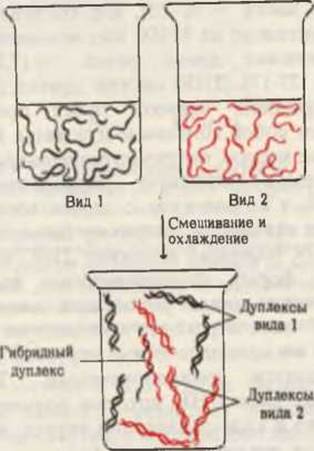
Fig. 27-15. Principle of the Hybridization assay. Two DNA preparations isolated from different species are heated until they completely denature and their strands separate. When these preparations are mixed and cooled slowly, the complementary DNA strands of each species find one another and renature to form normal duplexes. If there is significant Structure/154.html">Sequence Homology between the two DNAs, hybrid molecules consisting of partial duplexes may form. The higher the degree of homology, the greater the likelihood of hybrid formation. The proportion of hybrids in the mixture can be measured by various Methods, notably Chromatography or density gradient centrifugation. Typically, to simplify the measurement Procedure, one of the DNA samples is labeled with a radioactive isotope.
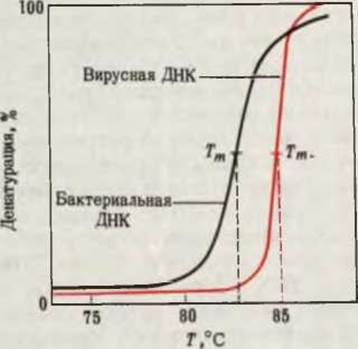
Fig. 27-16. Denaturation (melting) curves for two DNA preparations. The temperature corresponding to the midpoint of the transition (Tm) is called the melting point. Because the value of Tm depends on pH and salt concentration, the measurement conditions must always be explicitly specified.
Last update: 06/08/2026
Editorial and Educational Adaptation: This material has been compiled based on the primary/original source text. The project team performed an editorial review, corrected technical inaccuracies, structured sections, and adapted the content for an educational format.
What was processed:
- elimination of formatting defects (OCR errors, structural breaks, corrupted characters);
- editorial organization of content;
- standardization of terminology in accordance with academic sources;
- verification of factual statements against the original source text.
All mentions of the author, publication year, and origin of the primary text have been preserved in accordance with the source.