Principles of Biochemistry, Volume 3 - A. Lehninger 1985
Selected Aspects of Human Biochemistry
Human Nutrition
Dental caries is an important nutrition-related problem
Dental caries is considered one of the most prevalent diseases in the United States; compared to other Nutrition-related disorders, it is also the most widespread. In some areas, up to 90% of the population suffers from the consequences of dental caries, such as tooth loss, fillings, and dentures. A positive correlation is observed between the prevalence of caries and the consumption of refined sugars, which is why dental caries can be regarded as a disease characteristic of populations in highly developed countries.
Class="center">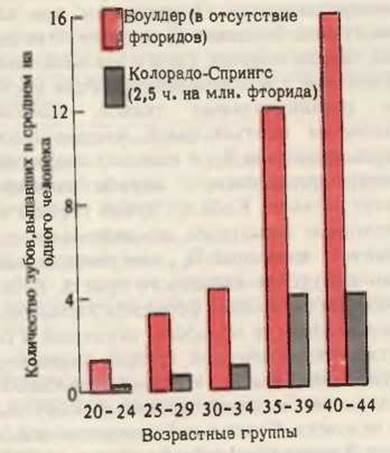
Fig. 26-27. Evidence of the beneficial effects of fluorides in two groups of Colorado residents. The number of lost Teeth per person (for individuals aged 40 to 44 years) was 16 in Boulder, compared to only 4 in Colorado Springs.
There is, however, another dietary factor that influences the incidence of dental caries. In comparative statistical studies on the prevalence of caries conducted in two groups of people, the first group received Water to which a certain amount of fluoride had been added, whereas the second group received unfluorinated water (Fig. 26-27). This study demonstrated that adding fluoride to water at a concentration of just 1 ppm significantly reduces the likelihood of developing dental caries. Currently, in the United States, over 9,000 water utility companies—supplying water to more than half of the US population—use fluorinated water in their municipal supply mains.
Unfortunately, some groups of urban residents have vigorously protested against the fluoridation of public water supplies. Some explained their protest by arguing that fluoride is a medication and they do not wish to be medicated, others saw it as an infringement upon their freedom of choice or personal rights, and some principled opponents adhere to The Theory of pure, unaltered foods. An excess of fluoride in drinking water is indeed harmful and can cause fluorosis, which is characterized by the mottling of teeth. This condition is found in children in certain Regions of the United States due to the high natural fluoride content in the local soil and water. However, fluoride is not a drug. It is an essential trace element whose presence in the diet is necessary for the proper formation of bones and teeth. Fluoride combines with hydroxyapatite—the crystalline mineral that makes up bones and teeth—to form fluorapatite (Fig. 26-28). Although fluorapatite constitutes only a small fraction of the bone's crystalline components, it is precisely its presence that imparts strength and acid resistance to the hydroxyapatite crystals. Natural and refined foods do not always contain sufficient amounts of fluorides, making the careful fluoridation of drinking water critically important, especially for growing children, as an adequate intake of fluorides from childhood is of paramount importance for proper development (Fig. 26-27).
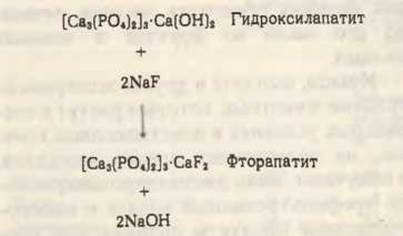
Fig. 26-28. Action of sodium fluoride on hydroxyapatite.
Last update: 06/08/2026
Editorial and Educational Adaptation: This material has been compiled based on the primary/original source text. The project team performed an editorial review, corrected technical inaccuracies, structured sections, and adapted the content for an educational format.
What was processed:
- elimination of formatting defects (OCR errors, structural breaks, corrupted characters);
- editorial organization of content;
- standardization of terminology in accordance with academic sources;
- verification of factual statements against the original source text.
All mentions of the author, publication year, and origin of the primary text have been preserved in accordance with the source.