Principles of Biochemistry Volume 3 - A. Lehninger 1985
Selected aspects of human biochemistry
Human nutrition
Goiter is a result of iodine deficiency
In some inland Regions of the globe—such as the mountainous areas of Europe, Central Africa, and the U.S. Midwest near the Great Lakes—enlargement of The Thyroid Gland, or simple goiter, is frequently observed (Fig. 26-26). This condition is primarily caused by a deficiency of iodine in the soil of remote, non-coastal areas. Although goiter has become increasingly rare in the United States due to the widespread availability of frozen seafood, it remains a significant global health concern.
Class="center">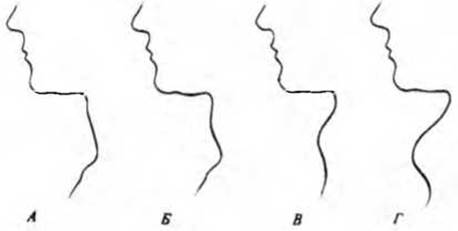
Fig. 26-26. Neck profiles at various stages of iodine-deficiency goiter: normal (A), early stage (B), moderate goiter (C), and severe goiter (D).
The thyroid gland concentrates iodine from the bloodstream and utilizes it to synthesize THYROID Hormones (see Section 25.19). When iodine is scarce, the thyroid undergoes compensatory enlargement to extract iodine from the Blood more efficiently. With prolonged iodine deficiency, the gland can grow to immense proportions—weighing several pounds—which can occasionally become life-threatening. Severe iodine deficiency in mothers can severely impair child development, leading to symptoms of cretinism, including intellectual disability, stunted growth, dwarfism, and characteristic facial features.
The Development of goiter is easily preventable. Iodized table salt (0.5 g of potassium iodide per 1 kg of NaCl) is readily available in the U.S. and is highly effective in preventing goiter formation; however, the populations who need it most do not always use it. Unfortunately, iodized salt is still not manufactured in many countries.
Last update: 06/08/2026
Editorial and Educational Adaptation: This material has been compiled based on the primary/original source text. The project team performed an editorial review, corrected technical inaccuracies, structured sections, and adapted the content for an educational format.
What was processed:
- elimination of formatting defects (OCR errors, structural breaks, corrupted characters);
- editorial organization of content;
- standardization of terminology in accordance with academic sources;
- verification of factual statements against the original source text.
All mentions of the author, publication year, and origin of the primary text have been preserved in accordance with the source.