Principles of Biochemistry Volume 3 - A. Lehninger 1985
Molecular Mechanisms of Genetic Information Transfer
More About Genes: Repair, Mutation, Recombination, and Cloning
Regions damaged by ultraviolet radiation can be excised and repaired
Under METABOLISM/18.html">The Influence of ultraviolet radiation, a covalent bond can form between two adjacent pyrimidine residues (most commonly two neighboring thymines) in bacterial DNA, resulting in a dimer (Fig. 30-1). If this damage is not repaired and the normal Introduction/20.html">DNA Structure is not restored, the resulting thymine dimer can become an insurmountable obstacle for DNA polymerase during Replication of the DNA segment beyond the dimer. In reality, Cells possess a damage removal (repair) mechanism. Thymine dimers are excised, and the gap is repaired through the sequential action of four Enzymes (Fig. 30-2). The first of these, known as UV endonuclease, cleaves the damaged strand on the 5' side of the thymine dimer. The second enzyme, DNA polymerase I, extends the open 3' end of this strand by adding the appropriate deoxyribonucleotides, synthesizing a short stretch of DNA complementary to the template strand. During this synthesis, the strand containing the thymine dimer is displaced. In the Third Stage, an endonuclease excises the defective segment. Finally, in the Fourth Stage, DNA ligase seals the newly synthesized complementary DNA patch to the nicked strand (Fig. 30-2).
Class="center">
Fig. 30-1. Formation of a thymine dimer induced by ultraviolet radiation.
Two new carbon-carbon bonds (highlighted in red) form between two adjacent thymine residues located on the same DNA strand. A. The structure of the dimer is shown in a flat projection, but it is better visualized in three dimensions as depicted in panel B, where the four-membered ring formed by the two new bonds is shaded.
Pyrimidine dimers form and are repaired not only in UV-irradiated Bacteria, but also in human Skin cells exposed to direct sunlight. However, in xeroderma pigmentosum—a rare human genetic disorder—the enzymatic repair mechanism for UV-induced damage is defective. Under these conditions, the skin becomes extremely sensitive to sunlight. It turns very dry and thin, skin Cell proliferation is abnormal, and affected individuals almost invariably develop skin Cancer. The skin of such patients must be meticulously protected from sunlight; otherwise, the disease is frequently fatal. Biochemical and genetic studies have revealed that in the most common form of xeroderma pigmentosum, the defect lies in UV endonuclease, the enzyme that introduces a strand break on the 5' side of the pyrimidine dimer. Thus, a malfunction in just a single enzyme can make sunlight exposure lethal to the skin.
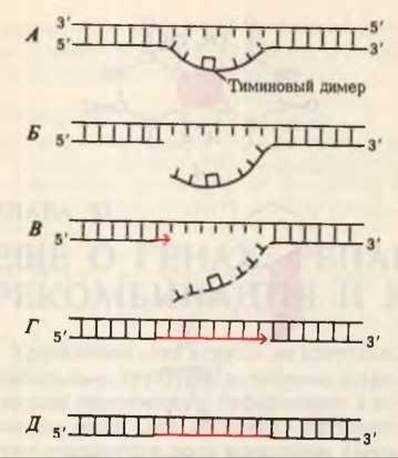
Fig. 30-2. A. Repair of a thymine dimer. B. A specialized UV endonuclease cleaves the damaged strand on the 5' side of the dimer. C. DNA polymerase I begins to "patch" the strand, while a 5'→3' endonuclease removes the thymine dimer and several adjacent NUCLEOTIDES. D. The new DNA segment is completed. E. The new segment is joined to the main strand by the action of DNA ligase.
The ultraviolet component of sunlight responsible for skin pigmentation (sunning or tanning) is blocked by window Glass and various sunscreens containing chemical compounds that absorb ultraviolet light.
Last update: 06/08/2026
Editorial and Educational Adaptation: This material has been compiled based on the primary/original source text. The project team performed an editorial review, corrected technical inaccuracies, structured sections, and adapted the content for an educational format.
What was processed:
- elimination of formatting defects (OCR errors, structural breaks, corrupted characters);
- editorial organization of content;
- standardization of terminology in accordance with academic sources;
- verification of factual statements against the original source text.
All mentions of the author, publication year, and origin of the primary text have been preserved in accordance with the source.