Principles of Biochemistry Volume 2 - A. Lehninger 1985
Bioenergetics and Metabolism
Lipid Biosynthesis
The biosynthesis of triacylglycerols and glycerophospholipids begins with common precursors.
In animal Tissues, the Biosynthesis of triacylglycerols and major Phospholipids—phosphatidylethanolamine and phosphatidylcholine—begins with two common precursors and shares several initial steps. These common precursors are fatty acyl-CoA esters and glycerol 3-phosphate. Glycerol phosphate can be formed via two pathways. During Glycolysis, it is produced from dihydroxyacetone phosphate through the action of the cytoplasmic NAD-dependent enzyme glycerol phosphate dehydrogenase:
Class="center">Dihydroxyacetone phosphate + NADH + H+⇄
⇄ L-glycerol-3-phosphate + NAD+.
Alternatively, glycerol phosphate can be formed from glycerol through the action of glycerol kinase (Sec. 14.13):
ATP + Glycerol →
→ Glycerol-3-phosphate + ADP.
The other precursors for triacylglycerols are fatty acid CoA derivatives, which are produced with the help of acyl-CoA synthetases (Sec. 18.2):
Fatty acid + ATP +
+ CoA—SH → Acyl—S—CoA +
+ AMP + PPi
In the first step of triacylglycerol biosynthesis, two free hydroxyl groups of glycerol phosphate are acylated by two molecules of fatty acyl-CoA derivatives to yield diacylglycerol 3-phosphate (Fig. 21-13):
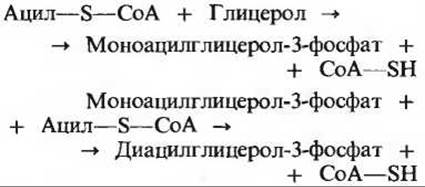
Diacylglycerol 3-phosphate (more commonly called phosphatidic acid) is found in Cells only in trace amounts; however, it serves as a crucial intermediate in Lipid Biosynthesis. During triacylglycerol synthesis, phosphatidate is hydrolyzed by phosphatidate phosphatase to yield 1,2-diacylglycerol (Fig. 21-13):
Phosphatidate + H2O →
→ 1,2-diacylglycerol + Pi.
By reacting with a third molecule of a fatty acyl-CoA derivative, diacylglycerol is subsequently converted into triacylglycerol:
Fatty acyl-CoA derivative +
+ 1,2-diacylglycerol →
→ Triacylglycerol + CoA—SH.
The formation of each ester bond in triacylglycerols requires a significant amount of Free energy. For an ester bond to form, the fatty acid must first be activated by conversion into a CoA ester; this reaction requires the energy of two high-energy phosphate bonds, as it is driven by the pyrophosphate Cleavage of ATP followed by the subsequent Hydrolysis of the resulting pyrophosphate.
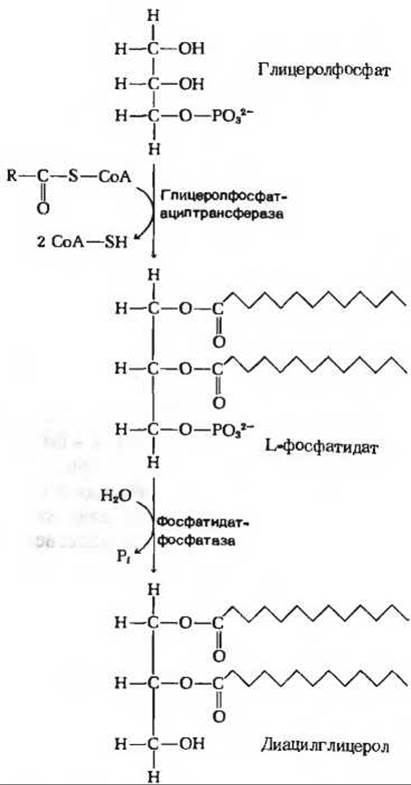
Fig. 21-13. Synthesis of diacylglycerols. The two fatty acid residues enter the reaction sequentially. Typically, two different long-chain fatty acid residues are incorporated into the R1 and R2 positions. It should be noted that in the diacylglycerol phosphate molecule, the length of the fatty acyl residues significantly exceeds the dimensions of the glycerol phosphate molecule (Sec. 12.2).
Last update: 06/08/2026
Editorial and Educational Adaptation: This material has been compiled based on the primary/original source text. The project team performed an editorial review, corrected technical inaccuracies, structured sections, and adapted the content for an educational format.
What was processed:
- elimination of formatting defects (OCR errors, structural breaks, corrupted characters);
- editorial organization of content;
- standardization of terminology in accordance with academic sources;
- verification of factual statements against the original source text.
All mentions of the author, publication year, and origin of the primary text have been preserved in accordance with the source.