Principles of Biochemistry Volume 2 - A. Lehninger 1985
Bioenergetics and Metabolism
Fatty Acid Oxidation in Animal Tissues
Regulation of Fatty Acid Oxidation and Ketone Body Formation
In the Liver, fatty acyl-CoA esters formed in the Cytosol can follow one of two major pathways. One involves their oxidation within the Cell/35.html">Mitochondria, while the other entails their conversion into triacylglycerols and Phospholipids catalyzed by cytosolic Enzymes. The actual metabolic fate of long-chain fatty acyl-CoA is determined by the rate at which they enter the mitochondria. A three-step transport mechanism by which the acyl groups—detached from cytosolic CoA esters—traverse the membrane into the mitochondrial matrix (via carnitine conjugation) regulates the overall rate of Fatty acid oxidation. Once these acyl groups enter the mitochondria, they are invariably oxidized there, ultimately undergoing complete conversion to acetyl-CoA.
Carnitine acyltransferase I, which catalyzes The transfer of acyl groups from fatty acyl-CoA to carnitine on the cytosolic face of The inner mitochondrial membrane, is an allosteric enzyme. It is specifically inhibited by its modulator, malonyl-CoA (Fig. 18-16), a metabolite not previously discussed. Malonyl-CoA is the initial intermediate in cytosolic Biosynthesis, wherein acetyl-CoA is converted into long-chain Fatty acids. The concentration of malonyl-CoA rises when an animal consumes a high-carbohydrate diet, because excess glucose that cannot be oxidized or stored as Glycogen is converted in the cytosol into triacylglycerols and stored in this form. Thus, fatty acid oxidation is "switched off" whenever the liver has an adequate supply of glucose for fuel and is actively synthesizing triacylglycerols from excess glucose. This shutdown is achieved through the allosteric inhibition of acyl group transport into the mitochondria.
Class="center">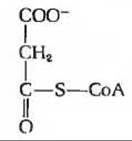
Fig. 18-16. Malonyl-CoA is the primary allosteric inhibitor of carnitine acyltransferase I. Malonyl-CoA serves as the first intermediate in the biosynthetic pathway leading from acetyl-CoA to long-chain fatty acids.
The Fate of acetyl-CoA generated in liver mitochondria via fatty acid oxidation can take two directions: it can either be oxidized to СО2 via The Citric Acid Cycle or converted into Ketone Bodies for export to peripheral Tissues. The chosen path depends primarily on the availability of sufficient oxaloacetate required for acetyl-CoA to enter The Citric Acid cycle. When oxaloacetate concentrations are very low, little acetyl-CoA enters the citric acid cycle, a condition that favors ketogenesis. Typically, an animal's oxaloacetate levels drop during starvation or when dietary carbohydrate intake is restricted. Under these conditions, The rate of fatty acid oxidation accelerates, and a substantial portion of the resulting acetyl-CoA is converted—via hydroxymethylglutaryl-CoA—into free acetoacetate and D-ß-hydroxybutyrate, which are then transported to peripheral tissues. There, ketone bodies serve as a major cellular fuel, undergoing complete oxidation to СО2 and Н2О via the citric acid cycle.
Last update: 06/08/2026
Editorial and Educational Adaptation: This material has been compiled based on the primary/original source text. The project team performed an editorial review, corrected technical inaccuracies, structured sections, and adapted the content for an educational format.
What was processed:
- elimination of formatting defects (OCR errors, structural breaks, corrupted characters);
- editorial organization of content;
- standardization of terminology in accordance with academic sources;
- verification of factual statements against the original source text.
All mentions of the author, publication year, and origin of the primary text have been preserved in accordance with the source.