Principles of Biochemistry, Volume 1 - A. Lehninger 1985
Biomolecules
Enzymes
Many enzymes catalyze reactions involving two substrates
We have already examined how Substrate Concentration affects The rate of a simple enzymatic reaction of the type A → P, which involves a single substrate molecule. In reality, however, many metabolic enzymatic reactions involve and bind to the enzyme two (and sometimes even three) molecules of different substrates. For example, in the reaction catalyzed by hexokinase, ATP and glucose are the substrates, while ADP and glucose-6-phosphate are the products:
Class="center">ATP + Glucose → ADP +
+ Glucose-6-phosphate.
The Michaelis-Menten approach can also be used to determine the rate of such bisubstrate reactions. As we have already seen, hexokinase is characterized by different K_M values for each of its two substrates (Table 9-4).
Enzymatic reactions involving two substrates usually involve The transfer of an atom or a functional group from one substrate to another. Such reactions can proceed via two different mechanisms (Fig. 9-5). In Reactions of the first type, called single-displacement reactions, two substrates, A and B, bind to the enzyme E either in a specific or random order to form an EAB complex, which then breaks down into products C and D. The second class of bisubstrate reactions consists of reactions that proceed via a double-displacement (or "ping-pong") mechanism. In these reactions, only one of the two substrates is bound to the Active Site of the enzyme at any given time. The binding of the first substrate is accompanied by the transfer of its functional group to the enzyme molecule. Only after the product formed from the first substrate is released can the second substrate bind to the enzyme and accept the functional group.
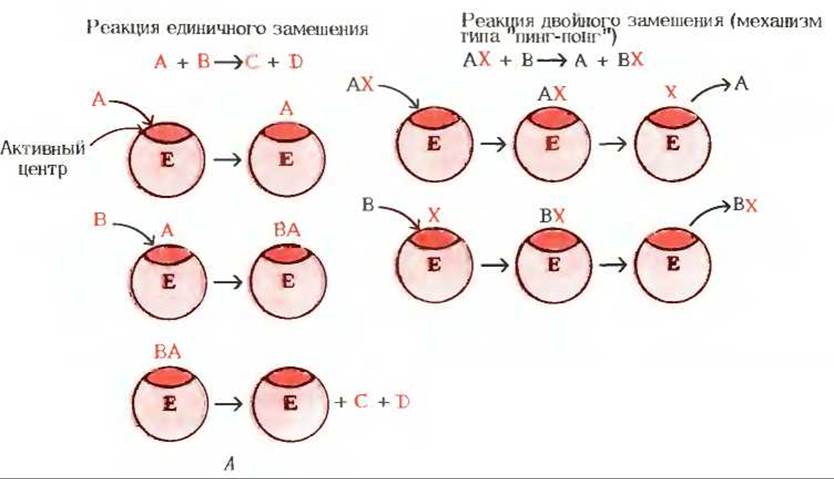
Fig. 9-5. Schematic representation of bisubstrate reactions belonging to two different classes. A. Single-displacement reaction. In some reactions of this type, substrates A and B can bind to the enzyme in any sequence; in others, There is a specific order of binding for A and B. B. Double-displacement reaction (ping-pong mechanism). The first substrate, AX, transfers group X to the enzyme. Then, after A is released, substrate B (the acceptor of group X) binds to the enzyme.
Last update: 06/08/2026
Editorial and Educational Adaptation: This material has been compiled based on the primary/original source text. The project team performed an editorial review, corrected technical inaccuracies, structured sections, and adapted the content for an educational format.
What was processed:
- elimination of formatting defects (OCR errors, structural breaks, corrupted characters);
- editorial organization of content;
- standardization of terminology in accordance with academic sources;
- verification of factual statements against the original source text.
All mentions of the author, publication year, and origin of the primary text have been preserved in accordance with the source.