Principles of Biochemistry, Volume 1 - A. Lehninger 1985
Biomolecules
Globular Proteins: Structure and Function of Hemoglobin
Can a "molecular cure" be found for sickle-cell hemoglobin?
Although the sickle-Cell Gene in all probability conferred certain advantages to its carriers in those regions of Africa where malaria was rampant, today it is undoubtedly "harmful" to its possessors, especially for people of African descent who have migrated from Africa to other Regions of the world where malaria is rare and life expectancy is much higher. Based on the acquired knowledge of the Structure and conformation of Hemoglobin, attempts are being made to find a rational Treatment for Sickle-Cell Anemia. These efforts are directed toward finding therapeutic agents or chemical compounds that would have no adverse effects on the body and would be capable of interacting with one or more Functional groups of the hemoglobin S molecule, thereby preventing the harmful consequences of replacing glutamic acid with valine in the ß-chains. Several chemical compounds have already been found that, when added to a test tube with erythrocytes, almost completely prevent The formation of sickle-shaped Cells. For example, potassium cyanate reacts with certain amino groups of the hemoglobin S molecule, leading to the formation of carbamoyl derivatives of hemoglobin (Fig. 8-25); upon deoxygenation of these derivatives, erythrocytes do not assume a sickle shape. However, administering potassium cyanate to patients with sickle-cell anemia is unsafe, as this compound causes toxic side effects. Nevertheless, the search for effective remedies against sickle-cell anemia offers some hope that, ultimately, biochemical engineering Methods will allow the design of a compound that not only prevents the harmful effects of hemoglobin S but also has no adverse effects on other Proteins in the body.
Class="center">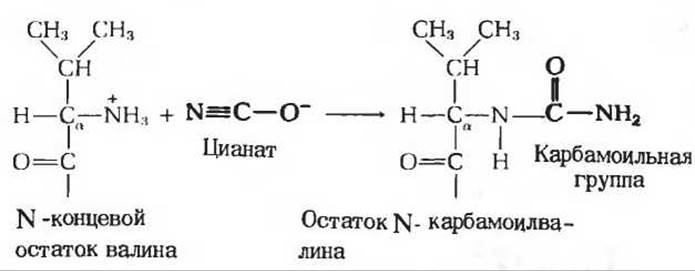
Fig. 8-25. Formation of the N-carbamoyl derivative of the N-terminal valine residue in the ß-chain of hemoglobin S upon treatment in vitro with potassium cyanate. After such chemical modification of only a single amino acid residue, the erythrocytes of sickle-cell anemia patients no longer assume a sickle shape upon deoxygenation.
Last update: 06/08/2026
Editorial and Educational Adaptation: This material has been compiled based on the primary/original source text. The project team performed an editorial review, corrected technical inaccuracies, structured sections, and adapted the content for an educational format.
What was processed:
- elimination of formatting defects (OCR errors, structural breaks, corrupted characters);
- editorial organization of content;
- standardization of terminology in accordance with academic sources;
- verification of factual statements against the original source text.
All mentions of the author, publication year, and origin of the primary text have been preserved in accordance with the source.