Principles of Biochemistry Volume 1 - A. Lehninger 1985
Biomolecules
Fibrillar proteins
In native $\alpha$-keratins, $\alpha$-helical polypeptide chains are twisted like a rope
Examining Hair or fur under an Electron microscope reveals—especially at fracture sites where the hair splits into individual filaments—that each hair consists of numerous fibrils, and that each fibril, in turn, is made up of even finer threads wound around one another like a rope. More detailed data obtained through X-Ray Diffraction Analysis led to the Conclusion that in hair, three α-helical polypeptide chains are twisted around each other to form a supercoiled Structure resembling a three-core cable (Fig. 7-9), in which each core is an α-Helix. In structures of this type, all constituent α-helical Polypeptides run in the same direction, so that all N-terminal residues are located at the same end. In the α-keratin of hair, The polypeptide chains are firmly linked together by covalent cross-links between cystine residues belonging to adjacent polypeptide chains. α-Keratins from different sources vary in their cystine content. The strongest and most rigid α-keratins, such as those found in turtle shells, contain up to 18% cystine.
Class="center">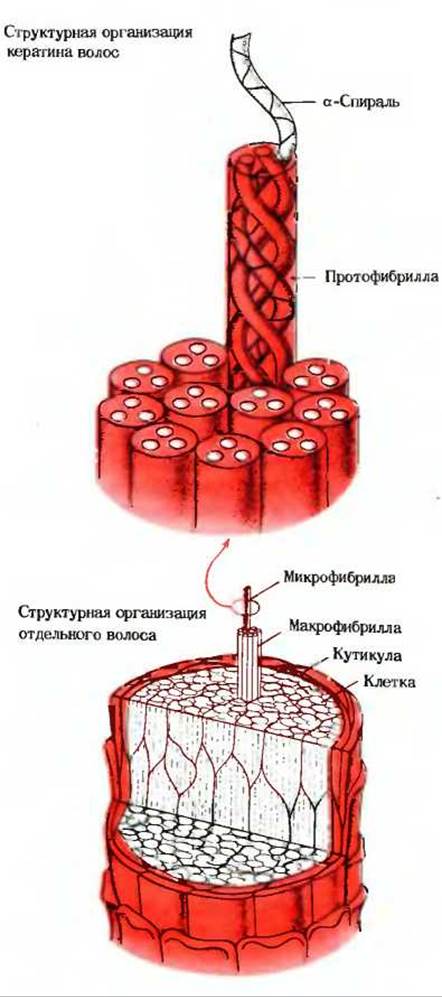
Fig. 7-9. Structure of hair and its constituent α-keratin. The fundamental structural element is the polypeptide chain of α-keratin in its native α-helical conformation. Three α-helical chains form a coiled (supercoiled) triple-stranded "rope"; 11 such ropes make up a hair microfibril.
Last update: 06/08/2026
Editorial and Educational Adaptation: This material has been compiled based on the primary/original source text. The project team performed an editorial review, corrected technical inaccuracies, structured sections, and adapted the content for an educational format.
What was processed:
- elimination of formatting defects (OCR errors, structural breaks, corrupted characters);
- editorial organization of content;
- standardization of terminology in accordance with academic sources;
- verification of factual statements against the original source text.
All mentions of the author, publication year, and origin of the primary text have been preserved in accordance with the source.