Fundamentals of Biochemical Engineering, Part 1 - Bailey J., Ollis D. 1989
Kinetics of substrate utilization, metabolite production, and biomass formation in cell cultures
Transient-state cell growth kinetics
Growth of filamentous organisms
In the preceding sections of this chapter, we examined microbial populations in which biomass increase is accompanied by a proportional rise in Cell number. The situation is quite different during the growth of Molds and other filamentous organisms; here, as the culture grows, both the mass and the Morphology of the pellets or mold suspension change over time. Experimental studies of submerged batch cultures have shown that biomass does not increase exponentially over time, but rather grows at a slower rate, such that the population mass is approximately proportional to the cube of time. To explain this relationship, we must first look at one- and two-dimensional mold cultures. In the case of a one-dimensional culture, The rate of colony elongation remains constant over time, whereas surface mold cultures (two-dimensional) are characterized by a constant rate of increase in the culture radius.
Extrapolating these results to a spherical pellet growing in a submerged culture, let us assume that
Class="center">
where R is the pellet radius. Since the biomass M is equal to

it follows from equations (7.59) and (7.60) that

Substituting the value of R from equation (7.60) into equation (7.61), we obtain

where

Integrating equation (7.62) with an initial biomass M0 yields

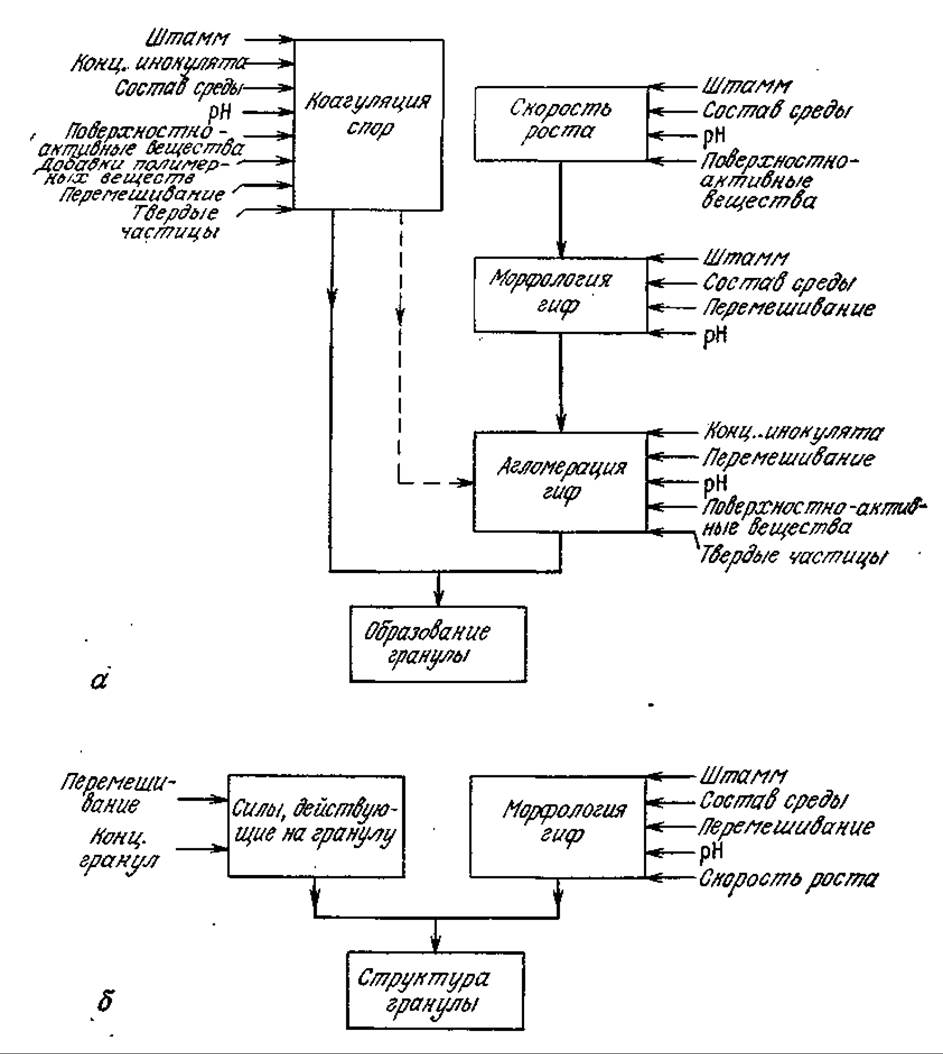
FIG. 7.21. Factors determining pellet formation (a) and its Structure (b) during the growth of mycelial organisms. [Reprinted with permission from Metz B., Kossen N. W. F., Biotechnology Review: The Growth of Molds in the Form of Pellets. — A Literature Review, Biotech. Bioeng., 19, 781 (1977).]
Since M0 is generally very small compared to M, equation (7.64) confirms the aforementioned proportional dependence of M on t3.
A comprehensive analysis of filamentous Organism growth must also account for The kinetics of pellet formation. Pellets originate either through spore agglomeration followed by subsequent growth or from the outgrowth of a single spore. Available data indicate that pellet formation is influenced by A wide variety of organism and environmental properties (Fig. 7.21). A general model for pellet formation kinetics has not yet been developed because the complex mechanisms underlying this phenomenon remain insufficiently studied and poorly understood.
When analyzing the growth of already formed pellets, the model described above can only be regarded as a very rough approximation. Pellet growth kinetics are inevitably influenced by pellet size, morphology, and internal structure—factors that, in turn, are governed by a combination of parameters such as agitation intensity, pellet concentration, organism properties, and medium composition [12]. Furthermore, pellet growth kinetics frequently depend on the diffusion-reaction interactions discussed in Section 4.4.
Last update: 06/08/2026
Editorial and Educational Adaptation: This material has been compiled based on the primary/original source text. The project team performed an editorial review, corrected technical inaccuracies, structured sections, and adapted the content for an educational format.
What was processed:
- elimination of formatting defects (OCR errors, structural breaks, corrupted characters);
- editorial organization of content;
- standardization of terminology in accordance with academic sources;
- verification of factual statements against the original source text.
All mentions of the author, publication year, and origin of the primary text have been preserved in accordance with the source.