Practical Protein Chemistry - A. Darbre 1989
Chemical Fragmentation of Polypeptides
Other Methods of Chemical Cleavage of Peptide Bonds
Cleavage at Proline Residues
Tertiary amines undergo Cleavage when treated with metallic sodium in liquid ammonia, yielding aldehydes and secondary amines [10]. The Cleavage of the N-peptide bond of Proline under these conditions was first observed in 1961 [85]. Consequently, attempts were made [8, 207] to employ Na solutions in NH3 for cleaving the proline bond in Proteins. During the reaction, The amino acid preceding the proline residue is converted into the corresponding aldehyde (84) or alcohol (85), accompanied by the cleavage of the second fragment with an N-terminal proline (86) [181, 207]. However, the method is not without drawbacks, the chief among them being non-specific cleavage and the degradation of Amino Acids susceptible to alkaline environments. As a result, attempts have been made to slightly modify the original Procedure. Sodium hydrazide in a hydrazine-ether medium at 0 °C for 45–60 min cleaves model Peptides and the B-chain of Insulin with a 70–100% yield [103].
Lithium aluminum hydride in anhydrous tetrahydrofuran was used for the cleavage of model peptides (containing a proline residue), gramicidin, and tyrocidine C [154, 155].
Class="center">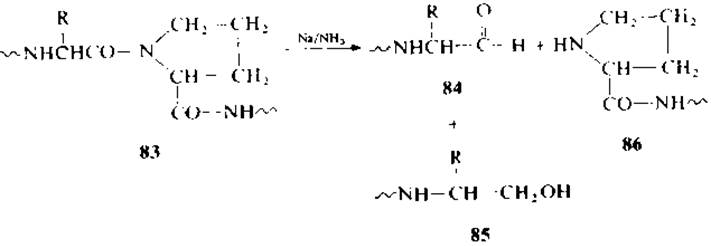
Last update: 06/08/2026
Editorial and Educational Adaptation: This material has been compiled based on the primary/original source text. The project team performed an editorial review, corrected technical inaccuracies, structured sections, and adapted the content for an educational format.
What was processed:
- elimination of formatting defects (OCR errors, structural breaks, corrupted characters);
- editorial organization of content;
- standardization of terminology in accordance with academic sources;
- verification of factual statements against the original source text.
All mentions of the author, publication year, and origin of the primary text have been preserved in accordance with the source.