Vertebrate Zoology - V. M. Konstantinov 2011
Chordates
Terrestrial, or Tetrapod, Vertebrates — Vertebrates with Amniotic Membranes
Class Birds — Subclass Fan-tailed Birds, or True Birds — Superorder Neognathae, or Typical Birds — Order Falconiformes, or Diurnal Birds of Prey
The order Falconiformes comprises 290 species of medium to large birds (body weight ranging from 35 g to 10–12 kg). These birds vary greatly in size and appearance, featuring a hooked bill with a bare, fleshy, yellow Skin at its base known as the cere. Their claws are curved to varying degrees, and their plumage is dense. Biologically, they are mostly predatory. Their behavior is complex; the mass of the cerebral hemispheres is 1.5 to 2 times greater than that of all other PARTS OF THE Brain. The crop is well developed, and some species are capable of consuming an amount of food equal to half their own body weight. The muscular gizzard is poorly developed. Hatchlings emerge from the egg with their eyes open and covered in down, but they develop slowly and remain in the nest for a long time, meaning they are altricial birds in terms of their individual development.
Class="center">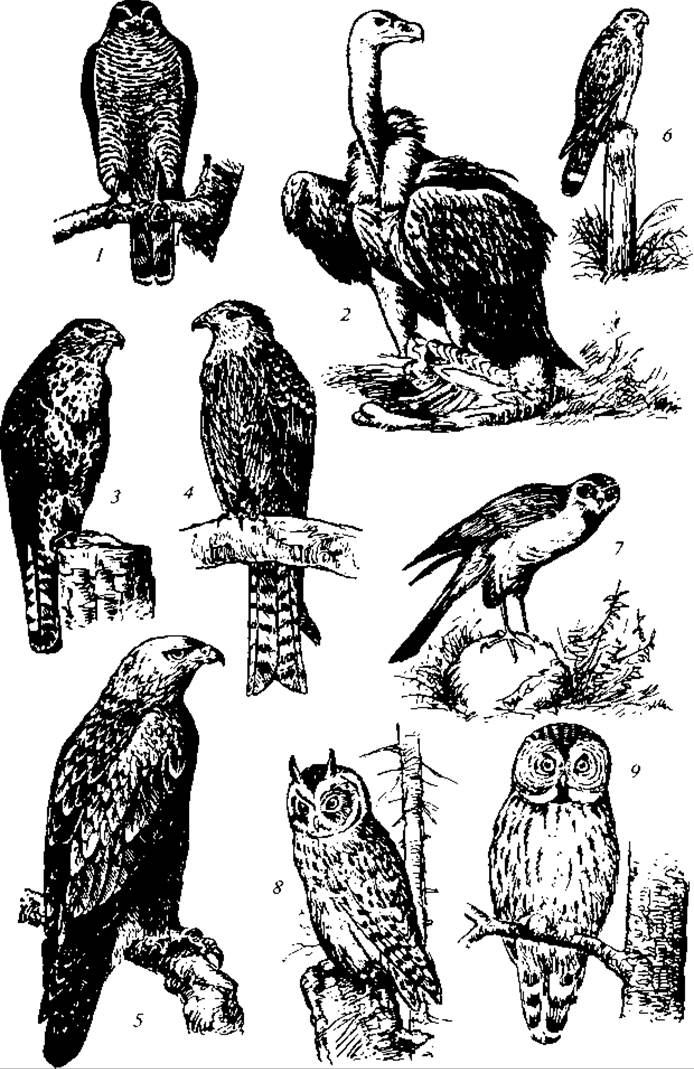
Fig. 147. Birds of prey:
1 — northern goshawk; 2 — lammergeier (snow vulture); 3 — common buzzard; 4 — black kite; 5 — golden eagle; 6 — common kestrel; 7 — hen harrier; 8 — long-eared owl; 9 — Ural owl
The family New World vultures (Cathartidae) is a small group distributed across South America and the southern half of North America. New World vultures walk well on the ground, but they search for food while in flight. Some species have a well-developed SENSE OF SMELL. Their nostrils communicate with each other because the nasal septum is absent. Ecologically, they are similar to our Old World vultures, feeding mainly on carrion and small vertebrates. In adaptation to scavenging, their HEAD and Neck are devoid of plumage. Several species inhabit mountains and steppes, and fewer live in forests. A typical species is the condor (Vulturgryphus), the largest representative of birds of prey: body length is 110 cm, wingspan is about 3 m, and body weight is 9–12 kg. It nests on cliffs. Clutches occur once every two years and consist of a single egg. Both parents incubate the egg in turn for about 2 months.
The family Falconidae (falcons) unites medium and small-sized representatives. The cutting edges of the upper Mandible bear a sharp tooth-like projection. The wings are long and pointed.
Large falcons—the peregrine falcon (F. peregrinus) and the gyrfalcon (F. gyrfalco)—feed mainly on birds, which they strike in mid-air during flight; they fly very rapidly. They nest in trees or on cliffs and precipices. In some regions, large falcons are tamed and used for falconry. Despite their extensive ranges, they are rare everywhere and are included in the Red Data Books of the Russian Federation and the IUCN.
Small falcon species—the red-footed falcon (F. vespertinus), the merlin (F. columbarius), and the kestrel (F. tinnunculus)—inhabit primarily open areas. They build nests on precipices, rocks, in piles of stones, and in trees. They are inferior in flight speed to the aforementioned species. They catch prey both in flight and on the ground, feeding on mouse-like rodents, insects, and less frequently birds (Fig. 147).
The kestrel and the red-footed falcon are beneficial to agriculture and forestry. The merlin is also a beneficial species, although it occasionally feeds on small birds.
The family Accipitridae (hawks and allies) encompasses many birds of prey. Their upper mandible lacks a tooth-like projection, and their wings are usually relatively short and blunt. The main groups of accipitrids in the fauna of Russia are described below.
Hawks—the northern goshawk (Accipiter gentilis, see Fig. 147) and the Eurasian sparrowhawk (A. nisus)—have short, blunt wings and a relatively long tail. These are forest birds adapted to fast and agile flight among trees and across clearings. They usually lie in wait for prey while perched deep within the foliage and catch it in flight, often also on the ground or by snatching it from branches. They feed almost exclusively on birds, including domestic ones, thereby causing some damage.
Harriers—the hen harrier (Circus cyaneus, see Fig. 147), the pallid harrier (C. macrourus), the western marsh harrier (C. aeruginosus), and others—are long-winged birds with long legs. They occur universally in open areas (except the tundra). They hunt small vertebrates by flying slowly just above the ground and snatching prey from its surface, out of the grass, or from bushes.
Kites (Milvus korshun, M. milvus) are easily distinguished from other birds of prey by their deeplyforked tail (see Fig. 147). They are most often found near rivers and lakes, usually employing a soaring flight. Their diet is diverse, but overall these birds are beneficial because their primary food consists of small rodents, susliks (ground squirrels), and weakened fish and birds.
Eagles differ from other members of the family by having feathered tarsi down to the toes, as well as broad, blunt wings. Their flight is fast but heavy. Seven species occur in Russia. The most common are the golden eagle (Aquila chrysaetus, see Fig. 147), widespread throughout the forest zone; the tawny eagle (A. nipalensis), inhabiting the southern steppe zone; and the greater spotted eagle (A. clanga), a dweller of the forest zone. All eagles nest in trees or on cliffs, with the exception of the tawny eagle, which builds its nest on the ground or less frequently in bushes. The clutch consists of two, rarely one or three eggs. Incubation lasts 40–45 days. They spot prey during smooth, soaring flight and catch it with a sudden pounce or by waiting in ambush while perched on the ground. Eagles also frequently feed on carrion.
Eagles, especially the tawny eagle, are beneficial: they destroy large numbers of rodents and insects that are harmful to agriculture. The golden eagle is used as a hunting bird for hunting foxes, wolves, and goitered gazelles.
Buzzards are closely related to eagles, but are smaller in size, and their tarsi are not fully feathered (see Fig. 147). In Russia, the common buzzard (Buteo buteo) is most frequently encountered, nesting in trees. Other species often nest on the ground, typically along riverbanks, ravines, or on large earthen mounds. The clutch contains 2–4 eggs, and the incubation period is about a month.
When hunting, buzzards soar in the air or lie in wait for prey while perched on a tree or some elevated vantage point. They catch small animals: mouse-like rodents, susliks, occasionally young hares, birds, lizards, snakes, frogs, and insects.
Buzzards destroy A large number of rodents and insects, which are pests of agriculture and forestry.
Vultures are typically very large birds, easily distinguished from other members of the family by the reduction of plumage on the head and neck. The bill is relatively low, and the claws are blunt. Biologically, they form a well-defined group, as they feed exclusively on carrion. Typical species are the Eurasian griffon vulture (Gyps fulvus), the cinereous vulture (Aegypius monachus), and the bearded vulture (Gypaetus barbatus). They are primarily inhabitants of mountainous regions and build their nests in trees and on cliffs. Some species (such as the griffon vulture) nest in colonies. The clutch contains 1–2 eggs, and the incubation period lasts up to 55 days. Both the female and male take turns incubating. Possessing exceptional eyesight, they locate food while soaring high in the air. These birds are beneficial. Among birds of prey, There are many rare and endangered species, 25 of which are included in the Red Data Book of the Russian Federation.
Last update: 13/08/2026
Editorial and Educational Adaptation: This material has been compiled based on the primary/original source text. The project team performed an editorial review, corrected technical inaccuracies, structured sections, and adapted the content for an educational format.
What was processed:
- elimination of formatting defects (OCR errors, structural breaks, corrupted characters);
- editorial organization of content;
- standardization of terminology in accordance with academic sources;
- verification of factual statements against the original source text.
All mentions of the author, publication year, and origin of the primary text have been preserved in accordance with the source.