Vertebrate Zoology - V. M. Konstantinov 2011
Chordates
Terrestrial, or Tetrapod, Vertebrates — Amniotes
Class Birds — Subclass Neornithes — Superorder Neognathae — Order Anseriformes
The order Anseriformes comprises approximately 200 species of medium-to-large waterfowl (body weight ranging from 200 g to 10 kg) characterized by long necks and short legs. They have four digits, three of which are directed forward and connected by web membranes. The bill is typically broad and dorsoventrally flattened. It is covered with a thin Skin externally, featuring a horny nail only at the tip. The inner margins of the upper Mandible are lined with horny lamellae, while some species (such as mergansers) possess serrated horny 'Teeth' along the jaw margins. The plumage is dense and rigid, with abundant down beneath the contour feathers, particularly on the ventral side of the body. The uropygial gland is well-developed. Males possess copulatory Organs. Reproduction occurs once a year, and the chicks are precocial.
They are distributed worldwide. The fauna of Russia includes approximately 60 regularly breeding species. Representatives of this order form The basis of commercial harvesting and game hunting. Numerous domestic breeds of ducks and geese have been developed. Russia is home to a single family, Anatidae, which is subdivided into several subfamilies.
The subfamily Swans (Cygninae) includes the largest Representatives of the order. There is no Sexual Dimorphism in plumage coloration. Three species are found in Russia, of which the whooper swan (Cygnus cygnus) and the mute swan (C. olor) are the most common. The former has an almost entirely black bill with a yellow base, and carries its neck vertically. The mute swan features a red bill with a characteristic black knob at the base, and curves its neck into an S-shape. The rarest is Bewick's swan (C. bewickii), which inhabits the Eurasian tundra.
Swans are widely but sporadically distributed. They nest on large, predominantly standing Water bodies with dense thickets of reeds or other vegetation, where they build their nests. Swans form pairs that are apparently maintained for life. The male stays near the nest but does not participate in incubation. The clutch typically consists of 3 to 8 eggs. The incubation period lasts 30 to 40 days. Swans feed in shallow water, snapping off submerged plant parts and digging up roots and tubers. While foraging, they frequently tip up vertically with their tails in the air, much like dabbling ducks. In autumn, they gather in large flocks for the molt, during which flightless molting swans are unable to fly. They acquire pure white plumage after their second year of life. Hunting swans is prohibited in Russia, and Bewick's swan is listed in the Red Data Book of Russia.
The subfamily Geese (Anserinae) comprises true geese and smaller brant geese. Sexual dimorphism is absent. Geese are very widely distributed, being particularly abundant in the tundra. The fauna of Russia includes eight species. The most widespread is the greylag goose (Anser anser), from which many domestic goose breeds are derived. The swan goose (A. cygnoides), the ancestor of so-called Chinese domestic geese, inhabits southern Eastern Siberia and China. Bean geese (A. fabalis) and brant geese (Branta) are numerous in the Arctic.
Geese inhabiting Russia are migratory birds that nest in sparsely populated areas rich in water bodies, marshes, and damp meadows. It should be noted that geese are primarily terrestrial rather than aquatic birds. They nest and forage on land, requiring water bodies for drinking, molting, and occasionally resting near human settlements. All geese swim well, but dive poorly.
Nests are typically built on land near water bodies, in dry tundra, floodplain meadows, among grass, and near lakes and estuaries. Both parents participate in nest building, but apparently only the female incubates. The male stays near her at his own 'bachelor' nest or grazes nearby. Clutch size is relatively uniform across all species (4 to 6, rarely more). The incubation period lasts 25 to 28 days. The chicks remain in the nest for no more than a day; once dry, they depart with the mother. Molting proceeds in a distinct manner: molting geese gather in flocks numbering in the hundreds or even thousands. During this period, the primary flight feathers are shed almost simultaneously, causing the birds to lose the power of flight. Molting geese congregate in inaccessible locations such as lakes with muddy shores, sea coasts, secluded bays, and islands.
The subfamily Dabbling ducks (Anatinae) comprises about 12 species in Russia. Most species exhibit sexual dimorphism. The speculum on the wing typically possesses a metallic sheen. The hind toe features only a narrow membranous lobe. The bill is relatively narrow and high. This subfamily includes the mallard (Anas platyrhynchos)—the ancestor of many domestic duck breeds—the gadwall (A. strepera), the northern pintail (A. acuta), small teals such as the garganey (A. querquedula), and several other species. The majority of species are extremely widespread.
The ducks described here prefer water bodies overgrown with herbaceous vegetation. They readily nest in marshes, provided these are sufficiently secluded. They distinctly avoid clear, deep lakes lacking vegetation. These ducks frequent shallows, which is associated with their foraging habits—feeding on aquatic plants and benthic organisms for which they cannot dive to great depths. Most species are predominantly herbivorous. They feed on pondweed tubers, seeds, leaves, shoots of hornwort, water lilies, amphibious bistort, sedges, bulrushes, reeds, duckweed, Algae, and aquatic invertebrates.
Nests are generally built on land and only occasionally in trees, tree hollows, or old nests of other birds. Nesting in trees occurs more frequently during prolonged and high spring floods, when nesting sites remain inundated longer than usual. Clutch sizes are large: 6 to 14 in mallards, 7 to 13 in gadwalls, and 6 to 12 in pintails. The incubation period lasts 24 to 28 days. Only the females incubate. They do not form large aggregations during the molt. They winter primarily on the Caspian Sea and hold significant game-hunting importance.
The subfamily Diving ducks (Aythyinae) includes ducks of various sizes with broad bills featuring a narrow nail. The membranous lobe of the hind toe is wide. The speculum is white, less frequently gray. The overall coloration in most species is less vivid than that of dabbling ducks. This subfamily includes various pochards and diving ducks: the common pochard (Aythya ferina), tufted duck (A. fuligula), common goldeneye (Bucephala clangula), velvet scoter (Melanitta fusca), and several eider species (Somateria).
Most species of these ducks are distributed in northern latitudes. Unlike dabbling ducks, they more frequently inhabit deep water bodies with sparse vegetation, often at sea. All are exceptional divers and forage by day in deep water, preying primarily on highly mobile animals. It is believed that diving ducks are capable of diving to depths of up to 10 m in marine environments.
Many species of diving ducks nest in colonies, mostly on the ground, though some (such as goldeneyes) typically nest in tree hollows. Many hold considerable commercial value, although their meat is coarser and possesses an unpleasant odor compared to that of true ducks.
Four eider species inhabit Russia. The general body conformation of eiders is typically duck-like. Body dimensions range from those of a medium-sized duck to a small goose. Breeding males are brightly colored. The overall coloration of females is uniform and brownish. Seasonal and age-related dimorphism is well-expressed. All species are inhabitants of the High North. Of greatest interest is the common eider (Somateria mollissima), which is circumpolarly distributed across the tundra belt, most commonly along sea coasts and less frequently in the forest-tundra.
Class="center">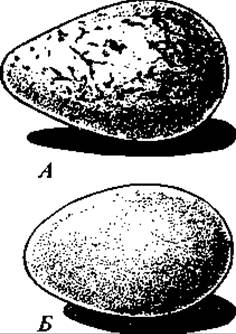
Fig. 146. Eggs of a common murre (A) and an eider (B)
Other eider species also inhabit the coasts of Arctic seas or the northern Pacific Ocean. For the winter, eiders do not migrate far from their breeding grounds, moving along the sea coast either westward or eastward toward ice-free seas, depending on the region. They build their nests in a variety of settings. The common eider frequently nests right along the coastline on rocky shores. Other eiders also nest in tundra bogs. Clutch sizes range from 3 to 8 eggs (Fig. 146). The incubation period is 28 days. Only the common eider forms substantial breeding colonies; other species nest solitarily. All eiders line their nests with exceptionally soft down plucked from the plumage of their bellies. When leaving the nest, the females cover the eggs with this down from above. Eiderdown is of great value: it is extremely warm, lightweight, and durable because it does not mat together. A single nest typically contains 18 to 21 g of down.
Eiders are trusting birds that easily grow accustomed to humans. This behavior facilitates the harvesting of down from eiders, which readily settle near human habitations. Hunting eiders is prohibited in Russia.
The subfamily Mergansers (Merginae) is characterized by a narrow bill with a hooked tip. The margins of the bill are lined with horny serrations. Mergansers feed on fish. They nest in tree hollows and other cavities. Four species inhabit Russia.
Last update: 13/08/2026
Editorial and Educational Adaptation: This material has been compiled based on the primary/original source text. The project team performed an editorial review, corrected technical inaccuracies, structured sections, and adapted the content for an educational format.
What was processed:
- elimination of formatting defects (OCR errors, structural breaks, corrupted characters);
- editorial organization of content;
- standardization of terminology in accordance with academic sources;
- verification of factual statements against the original source text.
All mentions of the author, publication year, and origin of the primary text have been preserved in accordance with the source.