Vertebrate Zoology - V. M. Konstantinov 2011
Chordates
Terrestrial, or Tetrapod, Vertebrates — Amniotes
Class Birds — Subclass Fan-tailed Birds, or Modern Birds — Superorder Neognathae, or Typical Birds — Order Gaviiformes
Neognathae are mostly flying birds whose Sternum features a well-developed keel and whose contour feathers have interlocked vanes. Apteria are present. The bones are pneumatic. Only a few flightless species have secondarily lost the keel, apteria, and bone pneumaticity. The tarsometatarsus always consists of completely fused Metatarsal Bones. The Pectoral Girdle is of standard avian Structure.
This superorder includes the vast majority of species. Currently, there is still no consensus on the Taxonomy of carinate birds, and various manuals indicate a different number of orders. The main orders are listed below, arranged According to the Classification by A. Wetmore (A. Wetmore, 1960).
An order represented by a single family and five species, uniting typically aquatic birds that are strong swimmers and divers, yet poor fliers and clumsy walkers. The legs are set far back, resulting in a nearly upright posture on land. The tarsus is laterally compressed. The neck is long; the bill is long, laterally compressed, straight, and sharp. The wings are short and pointed; flight is heavy. The three forward-facing toes are connected by a full web. They are incapable of normal locomotion on land. Feeding almost exclusively on fish, they dive with great skill and can remain underwater for several minutes. Sexual Dimorphism is absent. Common in Russia is the black-throated loon (Gavia arctica), slightly smaller than a goose, which nests on large lakes (Fig. 145).
Class="center">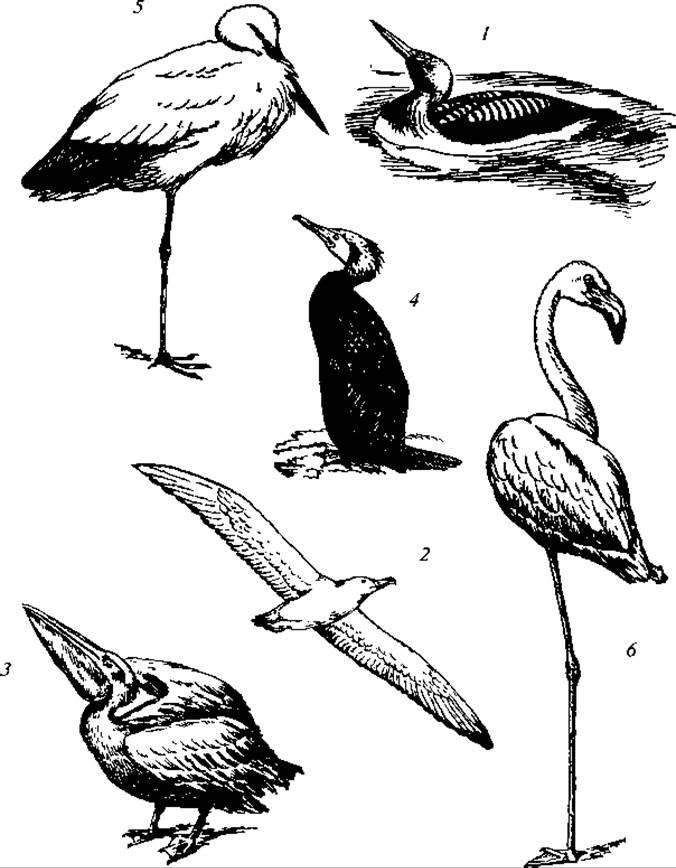
Fig. 145. Typical birds:
1 — black-throated loon; 2 — albatross; 3 — pelican; 4 — cormorant; 5 — white stork; 6 — flamingo
During the breeding season, loons live in pairs. They build a very primitive nest on low banks right at the Water's edge. When threatened, the incubating bird slides quietly into the water. The clutch size is 1 to 3 eggs, most commonly two; both the female and male share incubation duties in turns. In about 28 days, downy chicks hatch; almost immediately after emerging from the shell, they are capable of swimming (i.e., they are precocial chicks).
Last update: 13/08/2026
Editorial and Educational Adaptation: This material has been compiled based on the primary/original source text. The project team performed an editorial review, corrected technical inaccuracies, structured sections, and adapted the content for an educational format.
What was processed:
- elimination of formatting defects (OCR errors, structural breaks, corrupted characters);
- editorial organization of content;
- standardization of terminology in accordance with academic sources;
- verification of factual statements against the original source text.
All mentions of the author, publication year, and origin of the primary text have been preserved in accordance with the source.