Vertebrate Zoology - V. M. Konstantinov 2011
Chordates
Terrestrial, or Tetrapod, Vertebrates — Amniotes
Class Mammals — Subclass Theria — Suborder Toothed Whales — Order Perissodactyla
Members of the Order Perissodactyla are large animals in which the limb axis passes through the third digit, which becomes predominantly developed. The remaining digits are less developed or vestigial. The degree of reduction of the lateral digits varies among different groups, correlating with their greater or lesser adaptation to rapid running. Clavicles are absent. Once extremely numerous, this group is represented today by three well-defined extant branches: tapirs, rhinoceroses, and horses (Fig. 204).
The tapir family (Tapiridae) comprises heavy-set animals with four-toed front limbs and three-toed hind limbs. The Nose, fused with the upper lip, is extended into a short proboscis. The Skin is covered with short fur. The tail is very short. There are five species in total, four of which inhabit South America and one in Southeast Asia. They inhabit marshy forests, foraging along the banks of Water bodies and frequently within the water itself on aquatic and semi-aquatic vegetation. Their lifestyle is crepuscular or nocturnal.
The rhinoceros family (Rhinocerotidae) is likewise a relict group today. Modern species possess three-toed forelimbs and hind limbs, whereas certain extinct forms had four-toed limbs. The skin is hairless. One or two horns, originating from the epidermis, are situated on the frontal and nasal bones. Canines are reduced. Several species are distributed across South Asia and tropical Africa. Examples include the Indian rhinoceros (Rhinoceros unicornis) and the square-lipped African white rhinoceros (Ceratotherium simum). They inhabit forests and dense thickets of large shrubs. Their diet is herbivorous. At the beginning of the Quaternary period, rhinoceroses were also widespread in Europe and Siberia. Fossil remains of the woolly rhinoceros (Rhinoceros tichorinus), which lived contemporaneously with the mammoth, have been discovered within Russia. Rhinoceroses were particularly abundant during the Paleogene and Neogene epochs.
In members of the horse family (Equidae), only the third digit is developed, while the second and fourth digits are represented by small, skin-covered structures known as splint bones. The tail is long and furnished with Hair to a greater or lesser extent. Three extant genera are currently recognized.
True horses (Equus) also feature a uniform coat color, but their tails are covered with long hairs along almost their entire length. A single extant species of wild horse is known—Przewalski's horse (E. caballus), distributed in the mountain deserts of western Central Asia and discovered by our renowned explorer N. M. Przhevalsky. As late as the mid-19th century, wild horses were still found in the southern Russian steppes, where they were known as tarpans. According to the research of V. G. Heptner, tarpans do not constitute an independent species; they represent merely a localized geographic subspecies of Przewalski's horse. A herd of eight tarpans was observed in the steppes on the left bank of the lower Dnieper as late as the early 1870s. The last tarpan was killed there in 1876.
Class="center">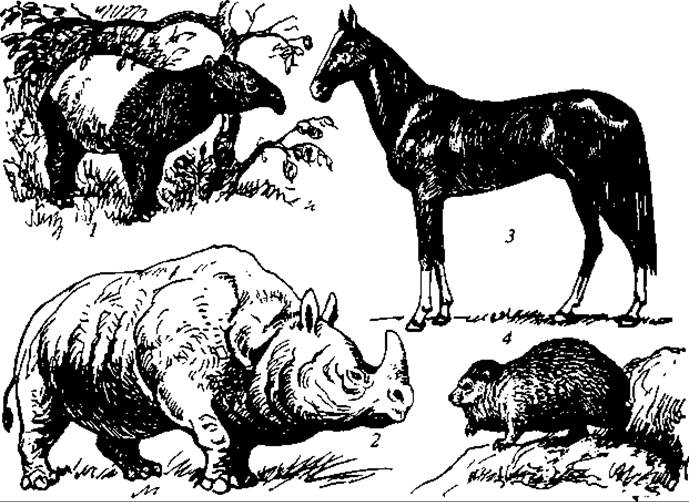
Fig. 204. Perissodactyls and hyraxes:
1 — Malayan tapir; 2 — Indian rhinoceros; 3 — horse; 4 — hyrax
The kulan (E. hemionus) is phylogenetically very close to true horses, and its common moniker, the Asian wild ass, is entirely inaccurate. As recently as historical times, it was widely distributed across the steppes of Eastern Europe, Kazakhstan, Central and Southwestern Asia. It currently occurs in southern Turkmenistan at the Badhyz Nature Reserve and has been acclimatized on Barsa-Kelmes Island in the Aral Sea. In other parts of Asia, kulan populations have declined sharply, and hunting them is prohibited. Zebras (E. zebra), or striped equids, inhabit African savannas; their tails bear long hair only on the terminal third. Donkeys (E. asinus) have a uniform coat color, with tail hairiness similar to that of zebras. Wild asses inhabit the deserts of Northeastern Africa.
All equids are gregarious animals, grazing in vast, predominantly open spaces and frequently consuming coarse, fibrous vegetation. Adaptations to life in such environments include rapid locomotion, a prolonged gestation period, and the birth of precocial young capable of following their mothers shortly after birth.
Last update: 13/08/2026
Editorial and Educational Adaptation: This material has been compiled based on the primary/original source text. The project team performed an editorial review, corrected technical inaccuracies, structured sections, and adapted the content for an educational format.
What was processed:
- elimination of formatting defects (OCR errors, structural breaks, corrupted characters);
- editorial organization of content;
- standardization of terminology in accordance with academic sources;
- verification of factual statements against the original source text.
All mentions of the author, publication year, and origin of the primary text have been preserved in accordance with the source.