INVERTEBRATE ZOOLOGY IN THREE VOLUMES - BOOK 2 - H.Y. Shcherbak - 1996
PHYLUM ARTHROPODA (ARTHROFODA)
SUBPHYLUM CHELICERATA (СНЕLIСERАТА)
CLASS ARACHNIDA (ARACHNIDA)
SUBCLASS HARVESTMEN (OPILIONES, OR PHALANGIDA)
Like pseudoscorpions, harvestmen are a very widespread group of arachnids found from tropical to polar Regions of the Earth. They inhabit A wide variety of biotypes, ranging from humid forests to dry steppes and deserts; some live high in the mountains near the limit of permanent snow. They are also common inhabitants of large cities.
Over 3,200 species are known, but their actual diversity in nature is undoubtedly much greater. Harvestmen remain poorly studied in Ukraine, where 42 species have been recorded; among the most common are Opilio parietinus and Phalangium opilio (Fig. 199).
Class="center">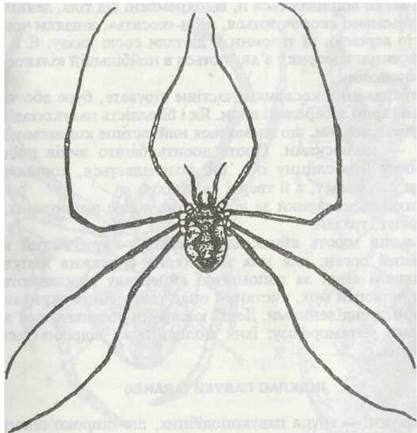
Fig. 199. Harvestmen: Phalangium opilio
Small in size (1–10 mm, rarely up to 2 cm), the body of a harvestman consists of a cephalothorax and a segmented abdomen. In many species, the abdominal tergites fuse with the cephalothorax shield to form a single dorsal shield.
The anterior part of the cephalothorax bears a pair of median eyes, often located on a raised tubercle. Sometimes the eyes are reduced. The chelicerae are chelate and short, except in species that feed on terrestrial Mollusks, where the chelicerae can be longer than the body. The pedipalps are either small and palp-like, or more massive, terminating in a claw and bearing spines on their segments. Gnathobases (masticatory lobes) are present on the basal segments of the pedipalps and anterior legs.
The body of a harvestman is supported by long, slender legs (with few exceptions where the legs are short), terminating in a multi-segmented tarsus (up to 100 segments) with claws. The tarsi easily wrap around grass stems, firmly holding the harvestman in place. The tarsus flexes through the action of specialized Muscles, whereas extension occurs via the pressure of hemolymph filling the tarsus—meaning that a musculo-mechanical principle is combined with a hydraulic one. A similar mechanism of terminal limb segment operation is characteristic of other arachnids as well.
The legs easily detach and, once separated from the body, continue to twitch convulsively for some time, seemingly "mowing" (hence, according to one theory, these animals received their common name in Ukrainian). There is also another interpretation: harvestmen appear in the greatest numbers during the haymaking season.
The coloration of harvestmen is typically grayish, brown, or black, though brightly colored species also exist. Like most arachnids, harvestmen are predators, feeding mostly on insects, while some species prey on mollusks. However, quite a few species consume decomposing animal and plant matter, swallowing not only liquid food but solid particles as well.
Harvestmen breathe using well-developed tracheae, similarly to solifuges.
Females possess an ovipositor, while males have a tubular copulatory organ; true copulation is characteristic of them. Fertilized eggs are deposited using the ovipositor into the soil, damp moss, leaf litter, etc. The eggs are coated with sticky secretions. Some harvestmen develop with elements of metamorphosis: their juveniles differ significantly in appearance from adults.
Last update: 13/08/2026
Editorial and Educational Adaptation: This material has been compiled based on the primary/original source text. The project team performed an editorial review, corrected technical inaccuracies, structured sections, and adapted the content for an educational format.
What was processed:
- elimination of formatting defects (OCR errors, structural breaks, corrupted characters);
- editorial organization of content;
- standardization of terminology in accordance with academic sources;
- verification of factual statements against the original source text.
All mentions of the author, publication year, and origin of the primary text have been preserved in accordance with the source.