Chordate Zoology - textbook - Y. V. Tsaryk - 2013
Chapter 4. DIVISION GNATHOSTOMATA, or ECTOBRANCHIATA. SUPERCLASS FISHES, PISCES
4.2. CLASS BONY FISHES, OSTEICHTHYES
4.2.3. Taxonomy of the Class of Bony Fishes and Characteristics of Representatives of Individual Orders
4.2.3.3. Group Teleost Fishes, Teleostei
4.2.3.3.7. Superorder Percomorpha
Percomorphs are characterized by sharp, spiny rays in their fins. The pelvic fins are located beneath or even in front of the pectoral fins. The scales are predominantly ctenoid, with a serrated free margin. The swim bladder is closed (physoclistous); it is reduced in some species. This is the largest superorder, comprising about 9,000 extant species, 200-230 families, and 10 orders.
Order Zeiformes. Approximately 50 species in 3-6 families.
The John Dory, Zeus faber, which is widespread in the North Atlantic, is occasionally found in the Black Sea (Fig. 4.52).
Class="center">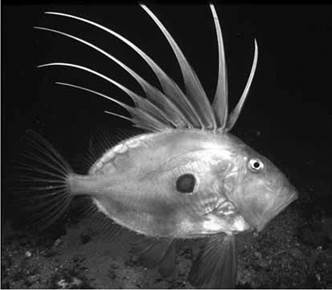
Fig. 4.52. John Dory Zeus faber
Order Gasterosteiformes. Many species in this order have a well-developed external armor of bony plates; they possess a more or less elongated, sometimes tubular snout. There are about 200 species in 9 families, consisting mostly of small marine and freshwater Fishes.
In Representatives of the stickleback family Gasterosteidae, there are sharp, strong spines in front of the dorsal fin and in each pelvic fin. In our waters, the three-spined stickleback Gasterosteus aculeatus is common, reaching a maximum length of 6-7 cm. Sticklebacks are characterized by parental care. In spring, the male builds a nest from pieces of plants bound together with Skin mucus, into which several females lay up to 100 eggs each. The male guards the nest, fans it with his fins to refresh the Water, and protects the young for some time. Sticklebacks feed on planktonic and benthic invertebrates, and also consume the eggs and fry of other fish. In some areas, they are extremely abundant. In the 1980s, immediately after the completion of land drainage reclamation, the weight share of sticklebacks in fish communities in certain watercourses of Polissya reached 40-65% (compared to 0.1-4% in the same area in 2000).
The family Syngnathidae includes pipefishes and seahorses (previously classified in a separate order, Lophobranchii). The snout is long and tube-like, with a small Mouth at the tip; the body is covered with bony plates (Fig. 4.53). Pelvic fins are absent. They inhabit the shallow waters of warm and temperate seas, hiding in seaweed beds or among coral branches; some species exhibit perfect mimicry, blending seamlessly with the Algae, and are able to change color depending on their surroundings. Some pipefish populations also live in freshwater bodies. They feed mainly on planktonic crustaceans, sucking them into their tubular mouth like a pipette from a distance of up to 4 cm; larger individuals (some pipefishes reach 60 cm in length, seahorses - 20 cm) prey on the fry of other fish. The eggs are deposited into a brood pouch on the male's abdomen; gas exchange for the embryos is provided by a dense network of Blood Vessels in the pouch's mucous membrane.

Fig. 4.53. Seahorse Hippocampus punctulatus
Order Mugiliformes. They have two widely separated dorsal fins; pelvic fins are located behind the pectorals. The scales are cycloid or ctenoid. There are about 150 species distributed in tropical and temperate seas, including many valuable commercial species. Barracudas resemble pikes in appearance—they are predators with large, sharp Teeth that hunt schooling fish and large invertebrates. The great barracuda Sphyraena barracuda reaches 2-3 m in length and can attack humans. Various species of mullets (genus Mugil) have a torpedo-shaped body and a small mouth with tiny teeth. They inhabit coastal waters and estuarine areas, feeding on detritus and benthic invertebrates. In the Black Sea, the sharpnose mullet Mugil saliens, the golden grey mullet Mugil auratus, and the flathead grey mullet Mugil cephalus (Fig. 4.54) are common; the Far Eastern so-iuy mullet Mugil soiny is farmed in estuaries.
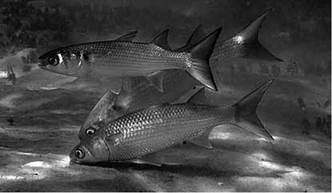
Fig. 4.54. Flathead grey mullet Mugil cephalus
Order Perciformes. This is the largest order of bony fishes, with over 6,500 species belonging to 140-160 families. Representatives of this order inhabit both fresh and marine waters, with particularly high species diversity in the tropics. Their sizes range from 1-2 cm in length and 10-30 mg in weight (some gobies, Schindleria, etc.) to 1-2 m and over 100 kg; some species are even larger: the swordfish Xiphias gladius can reach up to 4-4.5 m in length and 400-500 kg in weight, and the blue marlin Makaira nigricans can grow up to 5 m and 700-900 kg.
Tunas, horse mackerels, sailfishes, and swordfishes lead a pelagic lifestyle, hunting schooling fish and capable of reaching speeds of up to 100-130 km/h. Other pelagic forms (such as nototheniids) feed on planktonic crustaceans. Perches, pikeperches, and reef groupers lie in wait for prey from ambush or search for it while swimming slowly. Many gobies and blennies hide among rocks to ambush prey, while stargazers bury themselves in the sand, leaving only their eyes and a lure-like Tongue visible. Some blennies and labyrinth fishes (such as the climbing perch and mudskippers) crawl onto land to hunt terrestrial invertebrates. Deep-sea species are predators; some, like Chiasmodon, are capable of swallowing prey larger than themselves. There are also herbivorous species (some blennies, surgeonfishes, etc.).
In remoras (Echeneidae), the first dorsal fin has shifted to the HEAD and transformed into a powerful suction cup, which they use to attach themselves to large fish (and sometimes to boats and ships).
Their coloration is diverse, often cryptic (on coral reefs, camouflage can be provided by bright spots and stripes) or warning (aposematic). Some species can change color depending on their surroundings (gobies). Many species exhibit parental care. Gobies lay their eggs in empty shells or in nests built of pebbles; others dig burrows or build nests from air bubbles (labyrinth fishes). A significant portion of cichlids mouthbrood their eggs. Ovoviviparous species also occur (eelpouts, livebearers, etc.).
Many species of perciforms are of major commercial importance. Among our freshwater fish, the pikeperch Lucioperca lucioperca and the perch Perca fluviatilis are worth mentioning. Tilapia (Tilapia sp.) are farmed in tropical rice paddies. Among marine perciforms, commercial significance is held by drums (Sciaenidae), jacks and pompanos (Carangidae), cod icefishes (Nototheniidae), wolffishes (Anarhichadidae), gobies (Gobiidae), mackerels (Scombridae), and others. Many species of brightly colored small perciforms are kept in aquariums (paradise fish, Siamese fighting fish, gouramis, angelfish, etc.).
Order Scorpaeniformes. Over a thousand species of predominantly benthic or demersal marine fishes. They possess a suborbital stay (a bony ridge under the eye). Some rays of the dorsal, and sometimes other fins, have a deep groove containing secretory tissue that produces venom (such venom glands are also present in some perciforms and fishes of other orders). When injected into a wound during a fin sting, the venom causes pain, and in severe cases, paralysis and even death; it is used as a defense against predators.
Some species are typical ambush predators; others feed on large planktonic or benthic invertebrates. Many species—including rockfishes, greenlings, sablefish, sculpins, and bullheads—are of commercial importance.
Freshwater sculpins of the genus Cottus inhabit the fastest-flowing sections of mountain streams, hiding from predators and currents under rocks. In the headwaters of Carpathian rivers, the Alpine bullhead Cottus poecilopus exceeds all other fish several times over in Abundance and biomass. The black scorpionfish Scorpaena porcus is a common catch for spearfishers in the Black Sea (Fig. 4.55); it is also remarkable for periodically shedding its entire skin, which does not occur in other fish.

Fig. 4.55. Black scorpionfish, Scorpaena porcus
Order Pleuronectiformes. The order comprises about 500 species of bottom-dwelling fish from seven families. The body is laterally compressed, bordered by the dorsal and anal fins; both eyes in adult fish are located on one side of the head. The underside of the body is light, while the upper side is colored; depending on the color of the substrate, many flatfishes are able to quickly change their coloration, becoming inconspicuous on the bottom (Fig. 4.56).
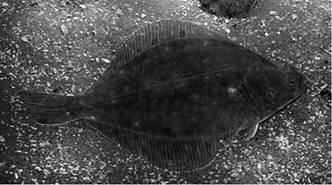
Fig. 4.56. European plaice Pleuronectes platessa on gravel substrate
They feed on fish and benthic invertebrates. In most species, the eggs are pelagic, floating to the upper water layers where they develop. The larvae have a symmetrical Structure. One of the largest flatfishes, the halibut Hippoglossus hippoglossus, grows up to 300 kg and 4.5 m. Many species are of great commercial importance. The Black Sea turbot Scophthalmus maeoticus is found in the Black Sea; the European flounder Platichthys flesus occurs in the Dnipro and other large rivers.
Order Tetraodontiformes. It comprises 10 families and about 300–350 species of fish inhabiting coastal waters of the tropics and subtropics; some species live in fresh water (the Nile River, Lake Chad). The premaxillary and maxillary bones are fused together (hence these fish are often called fused-jaw fish). The teeth are also fused, forming cutting plates. The mouth is small. Some species have an outgrowth of the gut that the fish can fill with water or air, inflating its body. The scales take the form of spiny or smooth plates, closely joined together or separate (boxfishes Kentrocapros, porcupinefishes Diodon) (Fig. 4.57).

Fig. 4.57. Longspined porcupinefish Diodon holacanthus (A) and spiny basketfish Kentrocapros aculeatus (B)
Some species have naked skin. Most are 10–40 cm long, but certain species reach enormous sizes. For example, the pelagic ocean sunfish Mola mola can be over 3 m long and weigh about 1.5 tons; they feed on various pelagic animals. Many species of this order lead a bottom-dwelling lifestyle. Their powerful jaw apparatus allows them to crush and crack open mollusk shells, bite off coral branches, and 'gnaw out' live polyps, sea urchins, and starfish. Some species are herbivorous. The eggs, milt, Liver, blood, and in some species, the skin and even flesh contain toxic substances of a hormonal nature that cause severe food poisoning. Despite this, some species are used for food by local populations in some areas.
Last update: 19/08/2026
Editorial and Educational Adaptation: This material has been compiled based on the primary/original source text. The project team performed an editorial review, corrected technical inaccuracies, structured sections, and adapted the content for an educational format.
What was processed:
- elimination of formatting defects (OCR errors, structural breaks, corrupted characters);
- editorial organization of content;
- standardization of terminology in accordance with academic sources;
- verification of factual statements against the original source text.
All mentions of the author, publication year, and origin of the primary text have been preserved in accordance with the source.