Chordate Zoology - textbook - Y. V. Tsaryk - 2013
Chapter 4. DIVISION GNATHOSTOMATA, or ECTOBRANCHIATA. SUPERCLASS PISCES
4.1. CLASS CHONDRICHTHYES
4.1.4. Taxonomy
4.1.4.1. Subclass Elasmobranchii
4.1.4.1.2. Superorder Batomorpha (Rays)
Unlike sharks, rays have gill slits on the ventral side (Fig. 4.17). Their body is flattened, and the edges of the pectoral fins are fused with the sides of the body and the HEAD. There is no nictitating membrane or anal fin. The Teeth lack the sharp cusps and edges characteristic of sharks. The spiracle is much better developed, as it participates in Respiration when the ray lies on the bottom. They reproduce by laying eggs or by giving birth to live young. They feed on a variety of animals, including plankton, Mollusks, and fish. The superorder includes more than 300 species.
Class="center">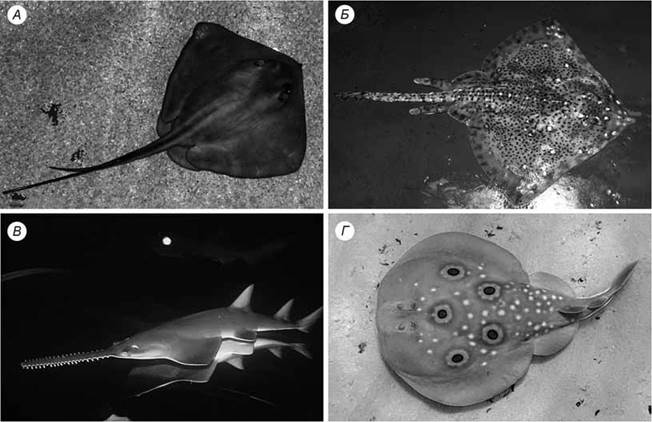
Fig. 4.17. Rays:
A - common stingray Dasyatis pastinaca; B - thornback ray Raja clavata;
C - smalltooth sawfish Pristis pectinata; D - marbled electric ray Torpedo marmorata
Order Pristiformes. The fish of this order resemble sharks in appearance. A typical representative is the smalltooth sawfish Pristis pectinata, which reaches a length of 5 m and a body weight of 300 kg. This is a typical viviparous form; inside the mother's womb, the embryo's snout is soft, and the teeth of the "saw" are hidden under the Skin until birth. Sawfishes hunt small benthic animals. These fish use their saw as a shovel and rake, as well as when attacking schools of small fish (mullet, sardines). The individual strikes the prey with its saw like a sword and then collects the dead fish from the bottom.
Order Rhinobatiformes. Almost all Representatives of the order are ovoviviparous. Locomotion in Water occurs due to the tail, rather than the pectoral fins, as other rays do. They feed on small fish, crustaceans, mollusks, and other benthic animals. Representatives of this order are caught off the coast of India and used for food, both fresh and salted.
Order Rajiformes. Benthic fish. They can change color depending on the color of the bottom. They have a pointed snout and a well-defined tail. The Movements of the pectoral fins during swimming resemble the flapping of wings. In all
European seas, including the Black Sea, lives the thornback ray Raja clavata. It reproduces by laying eggs, which develop for about five months (in other species of the order, 4–14 months). The horny egg capsules have four projections at the corners, which they use to cling to seaweed. The Mexican threadnose skate Springeria folirostris has an interesting shape. Its snout is widened and flattened before the thread-like elongation, forming a unique leaf-like Structure.
Order Dasyatiformes. Many representatives of this group have spines on their tails. The spines are laterally compressed and covered with large serrations. A groove with unicellular venom glands runs along the lower surface of the spine. The spine itself is immobile; however, by flexing its tail, the ray can deliver powerful blows with it. The force of the strike is such that the spine easily pierces leather shoes and penetrates deeply into The Human Body. The venom causes sharp spasmodic pain, muscular paralysis, rapid heartbeat, and vomiting.
The giant manta ray, Manta birostris, also belongs to this order. It is the largest of all rays, reaching up to 7 m in length and weighing 2 tons. This giant can leap out of the water to a height of 1.5 m, creating a sound like a cannon shot when it lands.
Order Torpediniformes. This order includes rays that inhabit tropical and subtropical waters of all oceans. They are characterized by electric Organs located between the head and pectoral fins. The mass of the electric organs can make up one-sixth of the body weight. The electric organ is controlled by a special lobe of the Brain. A single electric discharge lasts 0.003-0.050 s. The ray typically generates up to 100 consecutive pulses. The voltage of the pulses ranges from 8 to 300 V. The electric organs serve for orientation (as in the blind tropical ray, which has no eyes) and attack when hunting flounders, eels, salmon, and sharks.
They reproduce by ovoviviparity; the female "gives birth" to up to four young after a gestation period of nearly a year.
Last update: 19/08/2026
Editorial and Educational Adaptation: This material has been compiled based on the primary/original source text. The project team performed an editorial review, corrected technical inaccuracies, structured sections, and adapted the content for an educational format.
What was processed:
- elimination of formatting defects (OCR errors, structural breaks, corrupted characters);
- editorial organization of content;
- standardization of terminology in accordance with academic sources;
- verification of factual statements against the original source text.
All mentions of the author, publication year, and origin of the primary text have been preserved in accordance with the source.