General Microbiology - Schlegel, H. 1987
Fungi
Acrasids (cellular slime molds)
Unlike true slime Molds, which form a syncytial plasmodium, members of this order are also referred to as cellular slime molds (i.e., possessing a cellular Structure). Another name, "colonial amoebae," stems from The formation of characteristic fruiting bodies consisting of numerous aggregated naked amoebae. Given the external similarity of their fruiting bodies, it is instructive to compare the life cycles of acrasids and myxomycetes, as illustrated in Fig. 5.3.
Acrasiomycetes comprise about two dozen soil-dwelling species. The best-studied are Dictyostelium mucoroides and D. discoideum. These species are easily isolated from humus-rich soil. In pure culture on Agar or in liquid media, the amoebae feed on Bacteria (typically Escherichia coli or Enterobacter aerogenes Cells are used for this purpose in experiments).
Life cycle (Fig. 5.3, A). The primary vegetative form of acrasiomycetes consists of uninucleate, haploid, naked amoebae. These amoebae move across nutrient agar via pseudopodia, feed on bacteria (by phagocytosis), and reproduce. After a short time, they aggregate at a specific site to form an aggregation plasmodium. Unlike the multinucleate, yet unicellular plasmodium of true slime molds, this structure is termed a pseudoplasmodium. Although individual amoebae retain their autonomy, the pseudoplasmodium behaves as a cohesive unit. A Swelling develops upon it, from which the stalk of the fruiting body—the sorophore—differentiates. The upper cells become the stalk cells, which acquire a cellulosic sheath. The lower cells migrate to the apex of the stalk to form a spherical HEAD—the sorocarp—and subsequently transform into spores. These spores are essentially encysted amoebae. Upon spore germination, an opening forms in its cellulosic wall through which the amoeba emerges. A new life cycle can then begin.
Class="center">Table 5.1. Some important fungal groups
|
True slime molds (Myxomycetes) |
Lower Fungi (Phycomycetes) |
Higher fungi (Eumycetes) |
||
|
Sac fungi (Ascomycetes) |
Fungi imperfecti (Deuteromycetes) |
|||
|
Fuligo septica Lycogala epidendron Cribraria rufa Physarum Cellular slime molds (Acrasiomycetes) Dictyostelium |
Chytridiomycetes Chytridiales Blastocladiales Monoblephariales Oomycetes Saprolegnidales Leptomitales Peronosporales Plasmodiophoromycetes |
Protoascomycetes Endomycetaceae Saccharomycetaceae Euascomycetes Plectomycetes (cleistothecial fungi) Aspergillus Penicillium |
Heterobasidiomycetes Tremellales Uredinales Ustilaginales Homobasidiomycetes Hymenomycetes Polyporaceae Agaricaceae Boletaceae Hydnaceae Clavariaceae Corticiaceae |
Aspergillus Penicillium Phoma Monilia Candida Alternaria |
|
Zygomycetes Mucorales Entomophthorales |
Pyrenomycetes (perithecial fungi) Sordaria Neurospora Xylaria Nectria, Claviceps |
Gasteromycetes Lycoperdales Phallales Nidulariales |
||
|
Discomycetes (apothecial fungi) Rhytisma, Peziza, Helvella, Morchella, Tuber |
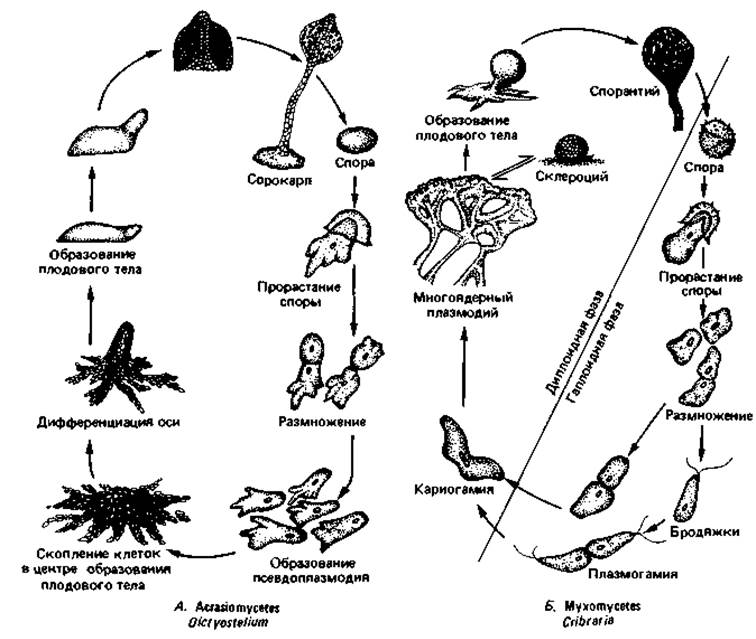
Fig. 5.3. Life cycles of acrasids and myxomycetes that form fruiting bodies. A. Life Cycle of the cellular slime mold Dictyostelium. Naked uninucleate amoebae form a "swarm" (aggregation plasmodium), which then differentiates into a fruiting body comprising a stalk and a head. B. Life cycle of a true slime mold. Myxamoebae aggregate into a multinucleate plasmodium, which gives rise to a fruiting body.
The vegetative growth phase is sharply separated from the morphogenetic phase. The pseudoplasmodium forms upon nutrient depletion. Aggregation can be delayed by periodically "feeding" the amoebae with bacteria.
The life cycle of acrasids serves as an excellent example of building an integrated multicellular complex from numerous independent cells. This aggregation and fruiting body formation process, which seemingly begins "on command from above," is apparently mediated by a diffusible substance previously named "acrasin." In Dictyostelium discoideum, this substance was identified as cyclic adenosine monophosphate (adenosine-3',5'-phosphate).
Last update: 13/08/2026
Editorial and Educational Adaptation: This material has been compiled based on the primary/original source text. The project team performed an editorial review, corrected technical inaccuracies, structured sections, and adapted the content for an educational format.
What was processed:
- elimination of formatting defects (OCR errors, structural breaks, corrupted characters);
- editorial organization of content;
- standardization of terminology in accordance with academic sources;
- verification of factual statements against the original source text.
All mentions of the author, publication year, and origin of the primary text have been preserved in accordance with the source.