GENERAL MICROBIOLOGY - T.P. Pyrog - 2004
14. TYPES OF FERMENTATION
14.5. MIXED-ACID FERMENTATION AND THE FAMILY ENTEROBACTERIACEAE
14.5.2. Fermentation Products and Metabolic Pathways
Hexose Catabolism proceeds via The Glycolytic Pathway, and very rarely through The pentose phosphate cycle. Gluconate catabolism occurs via the Entner-Doudoroff (KDPG) pathway. Depending on the Fermentation products formed, Two Types of mixed-acid fermentation are distinguished: 1) fermentation characteristic of Escherichia coli, where acids (formic, acetic, succinic, and lactic) are predominantly produced, with no 2,3-butanediol formation; 2) fermentation characteristic of Enterobacter, where 2,3-butanediol is the main product, and organic acids play a secondary role. These fermentation types differ in the reactions associated with Pyruvate METABOLISM.
Features of Escherichia coli fermentation. These features include:
1) Cleavage of pyruvate into acetyl-CoA and formate (formic acid); 2) breakdown of formate into СО2 and Н2; 3) reduction of acetyl-CoA to ethanol; 4) formation of succinate as a product of fumarate Respiration; 5) inability to form acetoin and 2,3-butanediol from pyruvate (Fig. 14.5).
Class="center">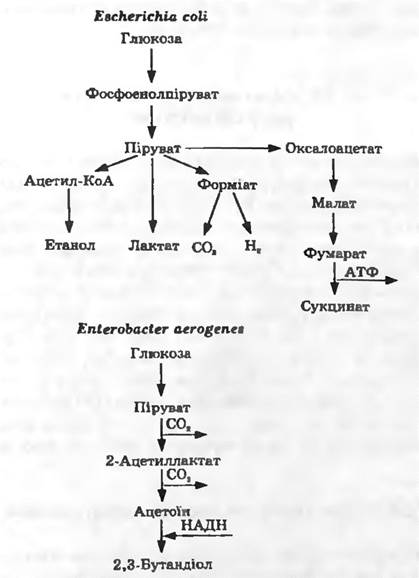
Fig. 14.5. Mixed-acid fermentation
Features of Enterobacter aerogenes fermentation. Acetoin is formed from two molecules of pyruvate (see Fig. 14.5). This process consists of two decarboxylation reactions accompanied by СО2 release. It is this intensive gas production that gave this bacterium its name. Acetolactate is an intermediate product. 2,3-Butanediol is produced via the reduction of acetoin mediated by NADH.
Last update: 12/08/2026
Editorial and Educational Adaptation: This material has been compiled based on the primary/original source text. The project team performed an editorial review, corrected technical inaccuracies, structured sections, and adapted the content for an educational format.
What was processed:
- elimination of formatting defects (OCR errors, structural breaks, corrupted characters);
- editorial organization of content;
- standardization of terminology in accordance with academic sources;
- verification of factual statements against the original source text.
All mentions of the author, publication year, and origin of the primary text have been preserved in accordance with the source.