GENERAL MICROBIOLOGY - T.P. Pyrog - 2004
14. TYPES OF FERMENTATION
14.2. ALCOHOLIC FERMENTATION
14.2.1. Ethanol Production by Yeasts
The Catabolism of glucose during its Fermentation to ethanol and СО2 proceeds via The Glycolytic Pathway. Glucose is oxidized to Pyruvate. The conversion of pyruvate to ethanol occurs in two steps (Fig. 14.2):
1) pyruvate is decarboxylated by pyruvate decarboxylase to acetaldehyde;
2) acetaldehyde is reduced to ethanol by Alcohol dehydrogenase with the participation of NADH. This reaction transfers the hydrogen generated during the dehydrogenation of triose phosphate. Thus, the redox balance is maintained.
Fermentation types discovered by C. Neuberg. If bisulfite (which is non-toxic to Yeasts) is added to glucose-fermenting yeasts, a new product—glycerol—appears, while the yields of ethanol and СО2 decrease simultaneously. Acetaldehyde binds with bisulfite to form acetaldehyde-bisulfite addition compound and therefore cannot serve as a hydrogen acceptor; thus, ethanol is not formed. Instead of acetaldehyde, dihydroxyacetone phosphate acts as this hydrogen acceptor. It is reduced to glycerol-3-phosphate and subsequently dephosphorylated to glycerol. Fermentation in the presence of bisulfite is used industrially to produce glycerol. This is Neuberg's second form of fermentation.
If sodium bicarbonate or disodium hydrogen phosphate is added to the solution during fermentation, glycerol is also produced. This occurs because acetaldehyde is converted into ethanol and acetic acid via a dismutation reaction, making it unavailable to serve as a hydrogen acceptor. This is Neuberg's third form of fermentation. The first form of fermentation is normal Yeast fermentation.
Class="center">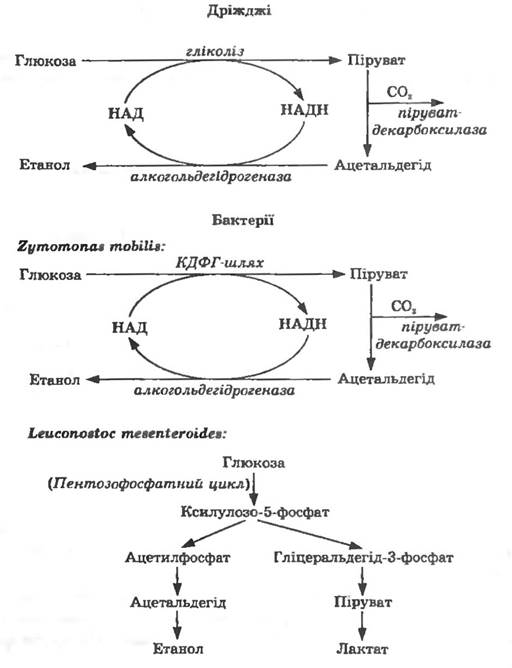
Fig. 14.2. Alcoholic Fermentation
The Pasteur Effect. The fermentation of glucose by yeasts is an anaerobic process, even though yeasts are aerobic microorganisms.
Under anaerobic conditions, fermentation proceeds very intensively, but Cell growth is weak. Upon aeration, fermentation slows down, Respiration begins, and active growth takes place. In some yeasts, fermentation can be almost completely suppressed by vigorous aeration (the Pasteur effect). L. Pasteur discovered this effect over a century ago. It is characteristic not only of yeasts, but also of all facultatively anaerobic Cells, including higher animal tissue cells.
Last update: 12/08/2026
Editorial and Educational Adaptation: This material has been compiled based on the primary/original source text. The project team performed an editorial review, corrected technical inaccuracies, structured sections, and adapted the content for an educational format.
What was processed:
- elimination of formatting defects (OCR errors, structural breaks, corrupted characters);
- editorial organization of content;
- standardization of terminology in accordance with academic sources;
- verification of factual statements against the original source text.
All mentions of the author, publication year, and origin of the primary text have been preserved in accordance with the source.