Fundamentals of Molecular Biology - V. I. Rezyapkin 2009
RNA, RNA Processing
tRNA Processing
Almost all tRNAs are synthesized as precursors—longer molecules known as pre-tRNAs. Processing involves the removal of flanking nucleotide sequences from the pre-tRNA. At the 5' end, the nucleotide chain is cleaved by an enzyme called RNase P. RNase P is a ribonucleoprotein in which the RNA component performs the catalytic function, while the protein plays a structural role. Bacterial RNase P contains a region complementary to the CCA terminus of tRNA, whereas eukaryotic RNase P recognizes different elements of the pre-tRNA precursor. At the 3' end of the pre-tRNA, an exonuclease acts by shortening the RNA progressively, removing one nucleotide at a time. During the final stages of tRNA maturation, polynucleotidyl transferase attaches the CCA sequence to the 3' end (Fig. 5.20).
Class="center">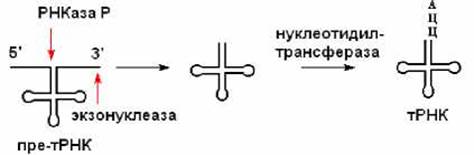
Fig. 5.20. General scheme of tRNA processing
In prokaryotes, the CCA sequence can be encoded within the tRNA genes; in such cases, polynucleotidyl transferase may not be required for the maturation of pre-tRNAs transcribed from these genes. However, sometimes the CCA sequence can be removed by an exonuclease during tRNA maturation, making the participation of nucleotide transferase necessary for its restoration.
In eukaryotes, the CCA sequence is not encoded in tRNA genes and is added post-transcriptionally.
In prokaryotes, a primary transcript may contain multiple tRNA sequences, and their processing involves the excision of individual tRNA molecules (Fig. 5.21).

Fig. 5.21. Processing of prokaryotic pre-tRNA may involve the excision of individual tRNAs
During tRNA maturation, the modification of nitrogenous bases also takes place, resulting in The formation of minor bases such as pseudouridine, dihydrouridine, thymidine, 7-methylguanosine, inosine, etc.
Pre-tRNA splicing
Some Yeast pre-tRNAs contain an intron located one nucleotide away from the 3' end of the anticodon. Intron sizes in various pre-tRNAs range from 14 to 64 NUCLEOTIDES. Pre-tRNAs lack the canonical intron-exon boundary sequences characteristic of pre-mRNAs. At the same time, introns contain sequences complementary to the anticodon. The pairing of these sequences with the anticodon presumably drives the formation of structures required for splicing to occur. During splicing, a nuclease excises the intron, while a ligase joins the two tRNA fragments through the formation of a phosphodiester bond, resulting in a covalently closed tRNA molecule (Fig. 5.22).

Fig. 5.22. Splicing of yeast tRNA
Last update: 12/08/2026
Editorial and Educational Adaptation: This material has been compiled based on the primary/original source text. The project team performed an editorial review, corrected technical inaccuracies, structured sections, and adapted the content for an educational format.
What was processed:
- elimination of formatting defects (OCR errors, structural breaks, corrupted characters);
- editorial organization of content;
- standardization of terminology in accordance with academic sources;
- verification of factual statements against the original source text.
All mentions of the author, publication year, and origin of the primary text have been preserved in accordance with the source.