Medical Genetics - V. M. Zaporozhan 2005
Multifactorial Diseases
Determination of Genetic Risk
Calculating genetic risk in multifactorial disorders is quite challenging, as accounting for all genetic and environmental factors is impossible. For instance, The Development of congenital hip dislocation depends on the following components:
— polygenically controlled acetabular shape;
— increased joint laxity inherited in an autosomal dominant manner;
— estrogen levels that affect joint mobility.
Due to the difficulty of determining risk in multifactorial pathology, special empirical risk tables are used.
The genetic prognosis in Multifactorial Diseases depends on the number of susceptibility genes. Risk magnitude is influenced by factors that indirectly allow for estimating the number of susceptibility genes:
1. Disease prevalence in the population. For siblings or children of an affected individual, the risk is calculated as the square ROOT of the disease frequency in the population; for multifactorial malformations with a population frequency of about 1/1000, the genetic risk averages 2–4%. If the disease frequency in the population exceeds 1% (common middle-age disorders), the risk is approximately 5–10% (according to J. M. Friedman).
2. Degree of relatedness to the affected family member (Table 7.5). The genetic risk is identical for all relatives who share the same proportion of genes with the affected person. The more distant the degree of kinship, the fewer genes relatives share, and the lower the probability of the disease. For example, the risk of cleft lip and palate is 4% for siblings (1st degree of relatedness), whereas for first cousins (2nd degree of relatedness) it is 0.5%.
Among relatives of the 4th and more distant degrees of kinship, the probability of the disease corresponds to the general population average.
Multifactorial diseases occur more frequently in consanguineous marriages because offspring in such cases inherit a larger number of susceptibility genes.
3. Number of affected relatives. The more affected individuals there are in the pedigree, the higher the risk of developing the disease. Thus, if one child in a family has a cleft lip and palate, the risk for siblings is 4%; if two children are affected, it is 10%. The risk of developing Diabetes Mellitus in a child is 1.8% if one parent is affected, and 12% if both are affected. For neural tube defects, the risk for siblings is 2–5% if one child is affected, and 10% after the birth of two affected children. This is associated with a potentially high number of susceptibility genes in the family.
4. Severity of the disease. Individuals with more severe clinical manifestations tend to carry a higher number of susceptibility genes. For instance, in unilateral cleft lip and palate, the sibling risk is 2.5%, whereas in bilateral cleft lip and palate, it is 4%.
5. In cases of gender-based differences in disease prevalence, the risk for relatives will be higher if the affected individual belongs to the less frequently affected sex, since they must possess a greater number of susceptibility genes.
Table 7.5. Percentage of identical genes in the genotype of relatives with various degrees of kinship
|
Degree of kinship |
Proportion of shared genes |
|
Monozygotic twins |
100% (1.0) |
|
1st degree of kinship (parents — children; full brothers and sisters, i.e., siblings) |
50% (1/2) |
|
2nd degree of kinship (uncle, aunt — nephew, niece; grandfather, grandmother — grandchildren; half-brothers and half-sisters, i.e., half-siblings) |
25% (1/4) |
|
3rd degree of kinship (first cousins) |
12.5% (1/8) |
|
4th degree of kinship (second cousins) |
3.125% (1/32) |
For example, pyloric stenosis occurs 5 times more frequently in boys than in girls. The risk for male siblings is 4% if the affected child in the family is a boy, and 9% if it is a girl. If congenital hip dislocation is diagnosed in a girl, the risk for male siblings will be 1%, and for female siblings, 5%; if the affected child is a boy, the risk for his brothers will be 5%, and for his sisters, 7%. This pattern is also characteristic of PEPTIC ULCER DISEASE (Fig. 7.2).
Empirical risks for certain multifactorial diseases are presented in Table 7.6.
During Genetic Counseling for families regarding multifactorial pathologies, one should keep in mind similar disorders inherited in a monogenic manner (see Table 7.1), as well as chromosomal and teratogenic syndromes. Empirical risk values cannot be applied if the disease is not inherited in a multifactorial manner. For instance, cleft lip and palate may be a symptom of approximately 200 monogenic, chromosomal, and teratogenic syndromes. In each of these cases, the risk will vary and depend on the mode of inheritance. Multifactorial birth defects can be distinguished by the Isolation of the defect.
Table 7.6. Empirical risk for certain multifactorial diseases and developmental malformations (S. I. Kozlova et al., 1996)
|
Diseases, malformations |
Empirical risk, % |
|
|
for siblings |
for offspring |
|
|
Anencephaly |
2–5 |
- |
|
Cleft lip ± palate |
4 |
4 |
|
Cleft palate |
2 |
6–7 |
|
2 |
- |
|
|
Hypospadias |
10 for brothers |
- |
|
Uncomplicated high-grade myopia |
10–15 |
10–15 |
|
Peptic ulcer disease |
9 |
- |
|
Psoriasis |
16 |
20 |
|
Atopic dermatitis |
16 |
- |
|
8–9 |
- |
|
|
3–12 |
- |
|
|
if one parent is affected |
10 |
|
|
if both father and mother are affected |
- |
40 |
|
Affective psychoses |
5–10 |
- |
Class="center">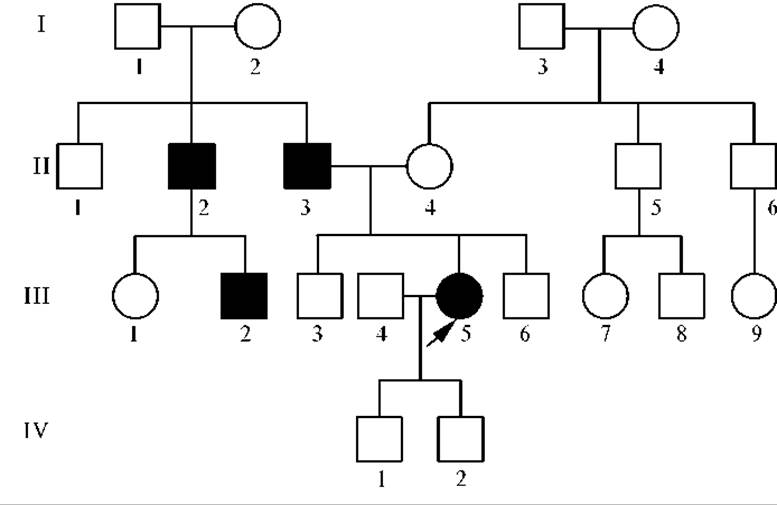
Fig. 7.2. Pedigree of a family with peptic ulcer disease. The risk for the proband's children is elevated because they are male (the more frequently affected sex) and the mother suffers from peptic ulcer disease (the less frequently affected sex, thus carrying a higher number of susceptibility genes)
Last update: 11/08/2026
Editorial and Educational Adaptation: This material has been compiled based on the primary/original source text. The project team performed an editorial review, corrected technical inaccuracies, structured sections, and adapted the content for an educational format.
What was processed:
- elimination of formatting defects (OCR errors, structural breaks, corrupted characters);
- editorial organization of content;
- standardization of terminology in accordance with academic sources;
- verification of factual statements against the original source text.
All mentions of the author, publication year, and origin of the primary text have been preserved in accordance with the source.