Genetics - A. V. Sivolob 2008
Genetics of Multicellular Eukaryotes
Epigenetic Inheritance
Gene Position Effect
The position effect, a phenomenon describing the dependence of Gene Expression on its chromosomal Location, was discovered quite some time ago and is directly related to the epigenetic Inheritance of the heterochromatic state.
One example of the position effect is illustrated in Fig. 6.12: a chromosomal rearrangement ARTIFICIALLY INDUCED IN Drosophila Germ Cells through the inversion of a region containing the wild-type w+ gene (red eyes) at one end, and a portion of the pericentromeric heterochromatin with a boundary element preventing heterochromatin spread at the other. Following this inversion, during early embryonic stages, the heterochromatin (now lacking the boundary) occasionally spreads into the adjacent w+ gene. This leads to gene silencing, and this heterochromatin Structure-dependent repressed state is inherited through mitosis. As a result, patches of white cells are formed, producing a mosaic eye phenotype.
If chromosomal rearrangements, unequal Crossing-over, or transposable element activity place a group of genes adjacent to a heterochromatic region, the frequency (probability) of their silencing depends on their precise linear order—genes located closer to the heterochromatic domain are silenced more frequently.
Class="center">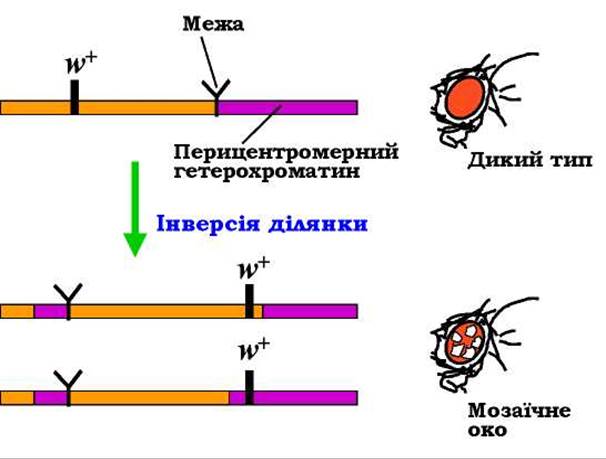
Fig. 6.12. An example of the gene position effect: formation of a mosaic eye in Drosophila
Last update: 11/08/2026
Editorial and Educational Adaptation: This material has been compiled based on the primary/original source text. The project team performed an editorial review, corrected technical inaccuracies, structured sections, and adapted the content for an educational format.
What was processed:
- elimination of formatting defects (OCR errors, structural breaks, corrupted characters);
- editorial organization of content;
- standardization of terminology in accordance with academic sources;
- verification of factual statements against the original source text.
All mentions of the author, publication year, and origin of the primary text have been preserved in accordance with the source.